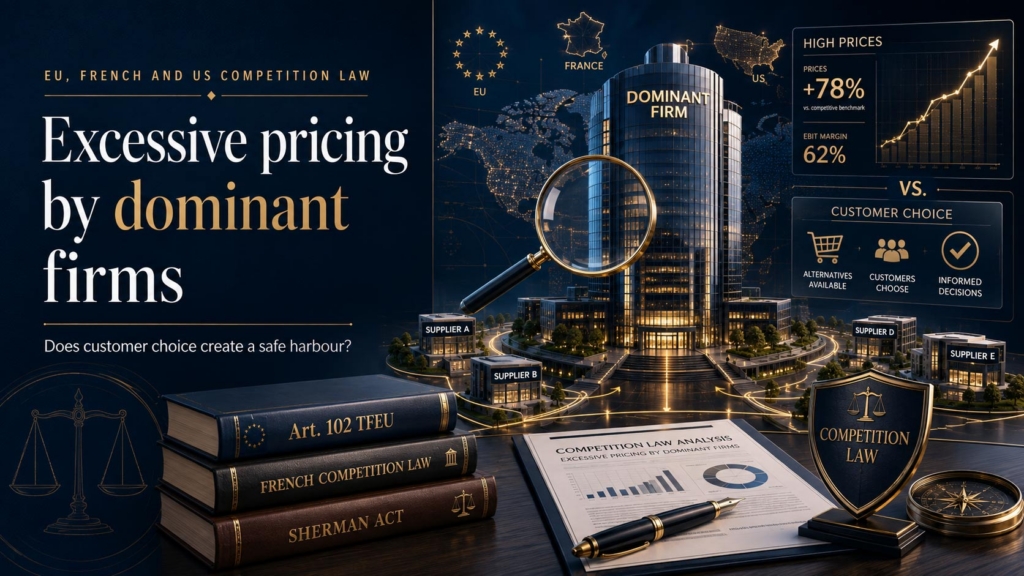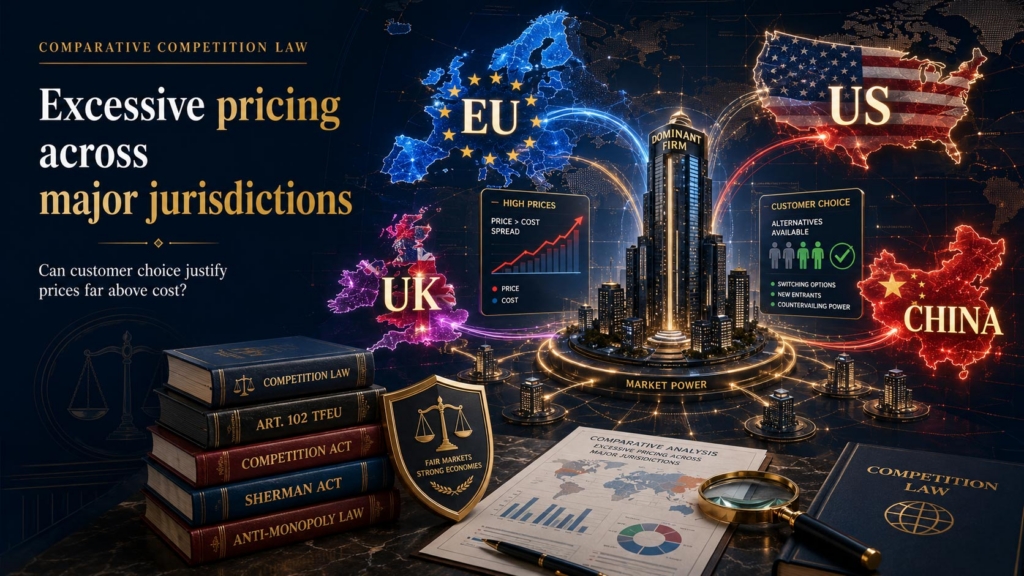
Excessive pricing by dominant companies is treated differently across major competition-law systems.
This debate tests whether customer choice preserves pricing freedom despite abuse-of-dominance rules and merger-control doctrines in the EU, United States, United Kingdom and China.
Check the analysis, the sources, the verdict and the concept training
The Thesis
European Union, United States, United Kingdom, China and other major merger-control jurisdictions. : A dominant company may lawfully charge prices far above its costs whenever customers remain free to purchase from another supplier .
This is clearly a stress test of Solsice Legal in comparative law. The debate will compare several jurisdictions together. This is not the best way to do it, but we wanted to see if the output is readable and makes sense legally speaking (spoiler: it does).
Legal Texts, Case Law, and Concepts Relied Upon
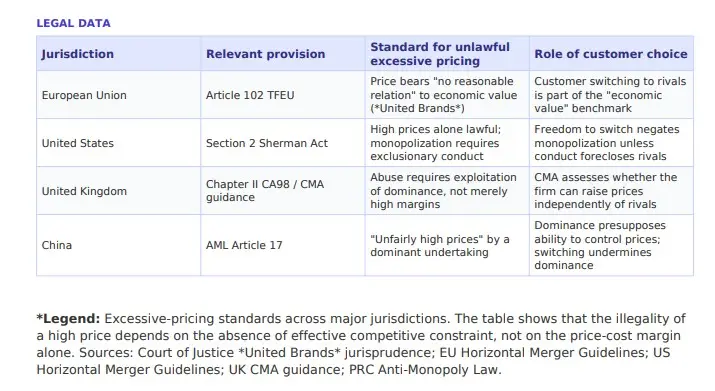
The statutory framework principally comprises Article 102 TFEU, Section 2 of the Sherman Act, Chapter II of the Competition Act 1998, and Article 17 of China’s Anti-Monopoly Law. The report also uses the EU and US horizontal merger guidelines and CMA guidance to examine dominance, abuse of dominance, exploitative excessive pricing, exclusionary conduct, economic value, effective competitive constraints and practical customer switching.
The principal judgments and decisions include United Brands v Commission, AKKA/LAA, Hoffmann-La Roche, Eastman Kodak, Verizon v Trinko, Brooke Group and the UK Pfizer/Flynn proceedings. Merger-control reasoning is illustrated through Siemens/Alstom, Sainsbury’s/Asda and China’s remedies in Nvidia/Mellanox.
Example of Tables Available in the PDF
Practical Context of excessive pricing by dominant companies
For internationally active businesses, the practical difficulty lies in separating lawful commercial pricing from exploitative abuse and distinguishing abuse-of-dominance enforcement from prospective merger control.
The report shows why the existence of another supplier may carry different legal weight depending on the jurisdiction and whether switching is genuinely effective or merely theoretical.
Summary
| Description | Details |
|---|---|
| Original report | https://solsicelegal.com/public/debates/european-union-united-states-united-kingdom-china-and-other-b28371835c0e |
| 47 pages. | |
| Language | English |
| Scores | Weighted TRUE: 2.60; weighted FALSE: 2.62; verdict: FALSE; confidence: 50%. |
| Think tank AIs | openai/gpt-5.6-luna-pro; google/gemini-3.5-flash-lite; moonshotai/kimi-k2.5; accounts/fireworks/models/deepseek-v4-pro; moonshotai/kimi-k2.7-code. |
| Clerk-arbitrator | tencent/hy3. |
| Data | Glossary terms: [metric unavailable]; 2 tables — a per-debate winner matrix and a cross-jurisdiction legal-basis comparison. |
| Quiz language | English |
Read the debates, check the sources, understand the verdict, and take the test