(French law) As of the date of this article (July 2026), the issue raised is not governed by any specific legal provision concerning the liability of e-invoicing platforms under French Law. Assessing the liability of electronic invoicing platforms (DPDs) therefore requires several areas of law to be considered together, along with some fundamental legal concepts.
In the absence of text, will Solsice Legal be able to identify and score the available remedies, as well as the contractual, regulatory and evidentiary obstacles? (spoiler : the answer is yes of course).
The MCQ in English is also interesting, as it introduces concepts of tax structuring, a field with which most non-specialized lawyers may not be familiar.
Check the debate, verdict and MCQ
The proposition to be defended
In French law, Companies using an e-invoicing platform cannot seek recourse against it for damages resulting from a data breach.
The proposition is deliberately contrarian ( “cannot seek recourse” ). Its purpose is to trigger a confrontation around the opposing arguments and determine whether a FALSE answer can be sustained and, if remedies are available, what those remedies might be.
A tournament between liability, contract and evidence
The graphical summary at the beginning of the debate shows that the AIs correctly identified the absence of a specific legal provision: “Key legal basis: no explicit citation.”
This does not mean that no legal remedies exist. It simply means that those remedies are not directly or specifically tied to the proposition being debated.
The TRUE camp therefore structures its reasoning around three main obstacles:
- contractual limitations of liability;
- the legal regime applicable to technical intermediaries;
- the difficulty for the company to establish fault, damage and a causal link between the two.
The FALSE camp’s rebuttals progressively shift the focus of the debate. Rather than denying the practical difficulties faced by a claimant, the opposing agents refuse to infer from those difficulties that legal recourse is impossible. They distinguish between the legal existence of a remedy and the practical likelihood of succeeding with that remedy.
Their arguments rely in particular on contractual liability, the GDPR, the rules governing limitation-of-liability clauses, and relevant case law.
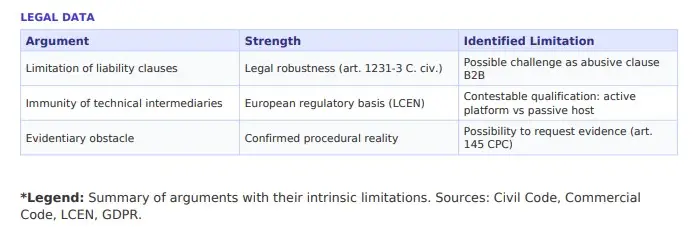
Exemple of data table (as the question targets French law)
A debate closely linked to the e-invoicing timetable
The debate is dated 24 July 2026, only a few weeks before the deployment of the new French electronic invoicing framework.
From 1 September 2026, the companies concerned must be capable of receiving electronic invoices through approved platforms.
This makes questions relating to cybersecurity, contractual allocation of risk and liability particularly significant, especially given the financial cost of using these platforms, which are private service providers rather than public services.
Debate summary
| Description | Details |
|---|---|
| View the final verdict | https://solsicelegal.com/public/debates/companies-using-the-e-invoicing-platform-cannot-exercise-rec-9e1f2fd6eba3 |
| 22 pages | |
| Language | English. |
| Scores | Weighted Score: TRUE = 0.00 / FALSE = 1.65 |
| Debating AIs | 3 debaters: z-ai/glm-5; openai/gpt-5.4-mini; anthropic/claude-opus-4.8 |
| Arbitrator-Clerk | deepseek/deepseek-v4-flash |
| Data | 36 glossary terms. 11 tables, including the confrontation matrix, applicable legal frameworks and a summary of possible remedies |
| Quiz | Yes, in English. |