Test of time constraint, Common Law 1818.
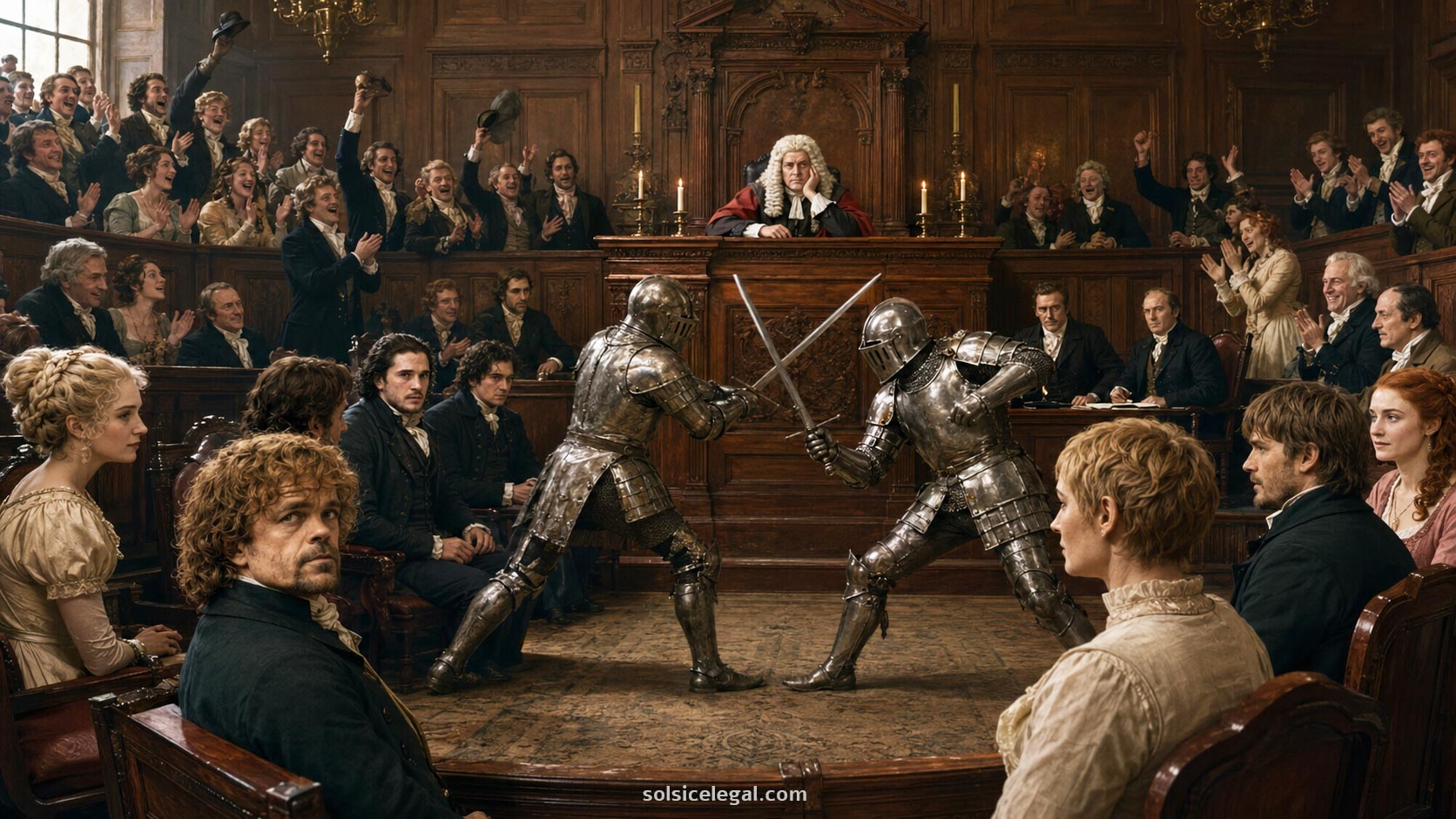
The trial by battle may sound like a relic of medieval folklore, or something taken straight from Game of Thrones. Yet the issue genuinely arose in England in 1818. The procedure had existed during the Middle Ages and had long since fallen into disuse. Crucially, however, it had never been formally abolished until 1819.
The debate raises a legal question that confronted nineteenth-century judges: under the common law, could an abandoned procedure remain legally enforceable so long as no rule had expressly abolished it?
The Thesis
“In England, a person acquitted of a murder charge but subsequently prosecuted through a private appeal of murder may lawfully require the outcome of the case to be determined by judicial combat — trial by battle or wager of battle — rather than by a jury trial: this form of combat is comparable to the ‘trial by combat’ depicted in Game of Thrones. Temporal constraint: the debate must be decided exclusively by reference to English law applicable as at 31 December 1818. Any legislation, case law or doctrinal development subsequent to 1818 must be excluded from the reasoning.”
The proposition requires the debaters to determine the precise state of the common law as at 31 December 1818.
The reference to Game of Thrones tests whether the debaters remain confined to genuine legal authorities, as intended, or whether one of them attempts to rely on fictional medieval material.
How the Debate Unfolded
The TRUE side builds its reasoning around the formal survival of the wager of battle. Its principal authorities are Ashford v Thornton (1818), Blackstone’s Commentaries on the Laws of England and the Statute of Westminster I. Its central argument is that desuetude alone does not extinguish a rule of common law: restrictions based on age, infirmity or the status of the parties may affect the exercise of the right without abolishing it.
The FALSE side attacks precisely this distinction: can a procedure whose institutional machinery, officers and actual practice have disappeared for centuries still be characterised as a genuinely enforceable legal right? It emphasises the disappearance of the medieval institutional framework, the existence of procedural exceptions, and the possibility of refusing battle where there was a strong presumption of guilt.
The rebuttals therefore focus less on whether trial by battle historically existed than on the boundary between formal legal validity and practical legal operability. The TRUE side argues that impracticability is not the same as illegality; the FALSE side responds that an unenforceable right risks becoming little more than a procedural fiction.
Finally, the analogy with Game of Thrones has no legal significance for the debaters and the arbitrator, although it is nevertheless addressed because the proposition expressly mentions it.
The analogy with the trial by combat depicted in Game of Thrones is not accidental: English law in 1818 genuinely recognised physical combat between the parties as a lawful mode of proof, rather than as fiction or metaphor. The rules governing such combat were strict and highly formalised, as illustrated by Thomas of Woodstock’s fourteenth-century Regulations for Judicial Combat, which were still cited as an authority in 1818. They provided that the combat was to take place before judges, with equal weapons and according to prescribed rituals, including oaths and clearly defined boundaries for the fighting ground. Victory belonged to the party who defeated his opponent or compelled him to confess, thereby bringing the dispute to a definitive end. Although rarely used in practice, the procedure could still be invoked as an existing legal right, particularly in cases where the evidence was considered insufficient for determination by a jury. The most famous illustration is Ashford v Thornton (1818): Abraham Thornton, accused of murder in a private appeal brought by the victim’s heir, demanded trial by battle, and the court was compelled to recognise the legal validity of his claim because Parliament had never abolished the procedure. It was only in 1819 that Parliament finally brought the practice to an end, thereby confirming a contrario that it remained lawful in 1818.
What the Arbitrator said
“The debate sets two conceptions of law against one another: the positivist-formal approach (TRUE) and the substantive-functional approach (FALSE). From a strictly positivist perspective, the TRUE position prevails: in the absence of any express abolition before 1819, and in light of the explicit recognition in Ashford v Thornton, it is undeniable that a person prosecuted by way of an appeal of murder could formally invoke trial by battle as at 31 December 1818.”
Debate Summary
| Description | Details |
|---|---|
| Original report | https://solsicelegal.com/public/debates/en-angleterre-une-personne-acquittee-d-une-accusation-de-meu-2b87510396e2 |
| 46 pages | |
| Original language | French (re-run the debate for the english version) |
| Scores | Weighted scores: TRUE = 3.78 / FALSE = 0.00. Final verdict: TRUE, with 90% confidence. The tournament records 4 TRUE verdicts and 0 FALSE verdicts across 4 debates. |
| Think tank AIs | 4 AIs: mistralai/mistral-large-2512; mistralai/mistral-large; google/gemini-3.5-flash-lite; moonshotai/kimi-k2.5 |
| Clerk-arbitrator | deepseek/deepseek-v4-pro |
| Data | A “Per-Debate Winner Matrix” presenting the TRUE/FALSE models, average scores, token counts, winner, verdict and confidence level for each of the four confrontations. |
| MCQ language | French (re-run the debate for the english version) |