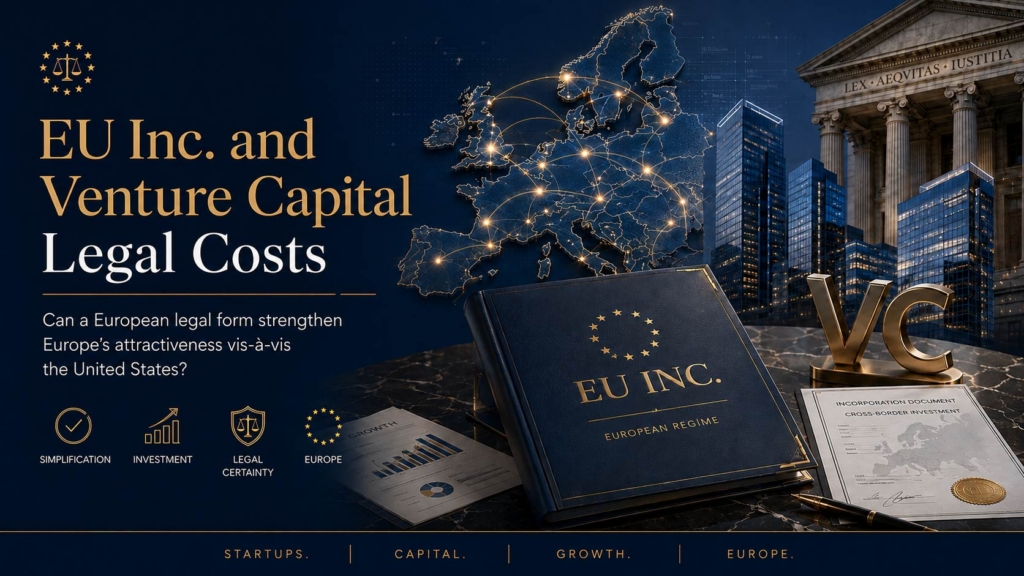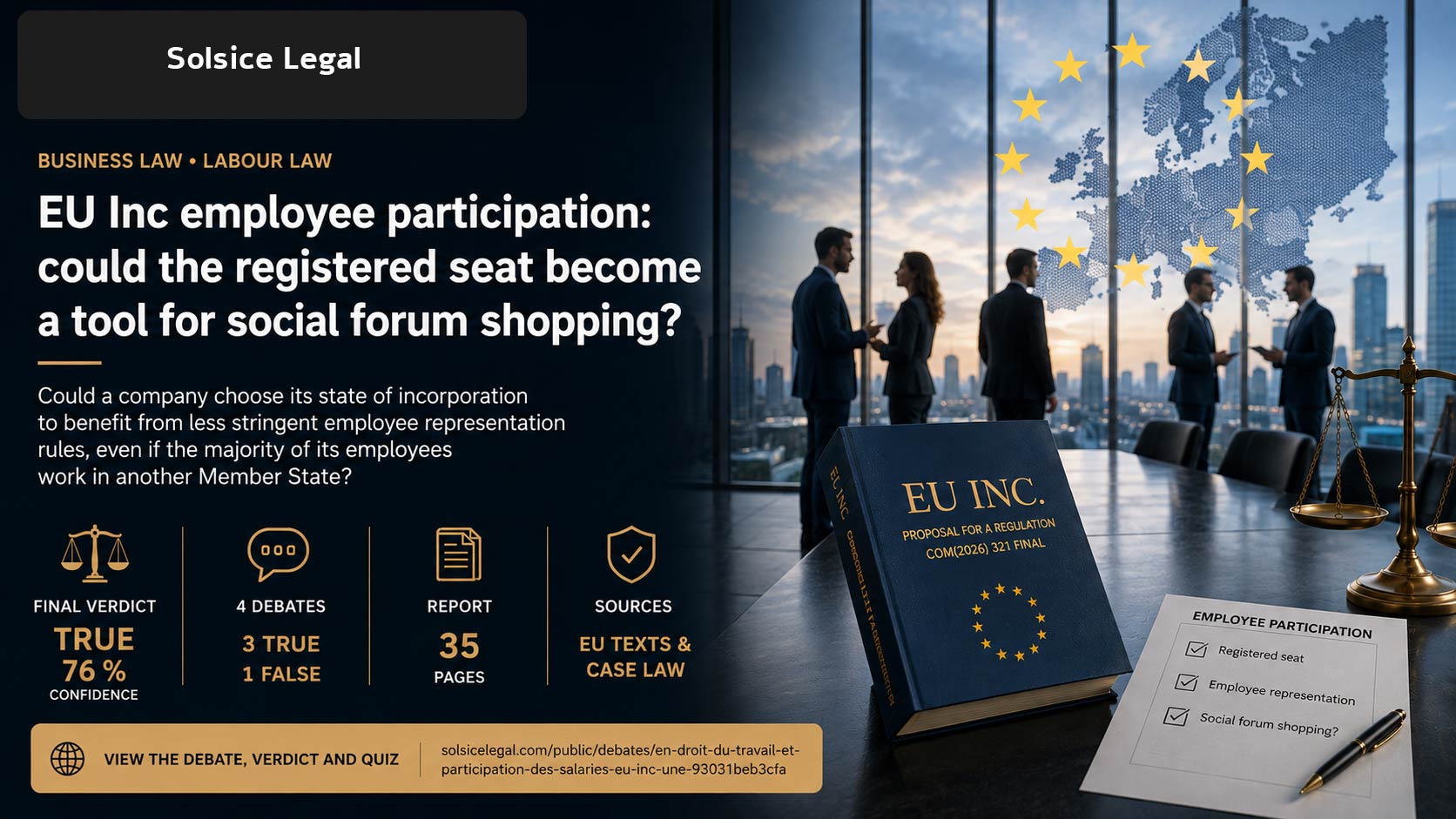
EU Inc employee participation raises a sensitive cross-border question: could a company incorporate in one Member State and thereby influence the employee representation regime applicable to its corporate governance, even where most of its workforce is located elsewhere?
View the debate, contrarian arguments, verdict, sources…
https://solsicelegal.com/public/debates/en-droit-du-travail-et-participation-des-salaries-eu-inc-une-93031beb3cfa
The proposition under debate
“In the context of employment law and employee participation applicable to a company incorporated under the EU Inc. regime, could a business use that status to choose the Member State offering the least onerous employee representation rules, even where the majority of its employees work in another Member State?”
The question focuses specifically on employee participation and representation within the corporate governance structure, and on the extent to which those rules may be connected to the company’s registered seat.
The distinction between employment law and employee participation
The potential for forum shopping arises because different connecting factors may apply to different aspects of the employment and corporate-governance relationship.
Legislation, case law and legal concepts considered
- EU Inc Regulation (project), COM(2026) 321 final, presented by the European Commission on 18 March 2026.
- For certain cross-border conversions, mergers and divisions, however, specific mechanisms under Directive (EU) 2017/1132 may apply.
- Freedom of establishment; Polbud; Cadbury Schweppes; Erzberger; the Societas Europaea regime; Directive 2001/86/EC on employee involvement; and the mechanisms governing special negotiating bodies.
- The report further distinguishes between the lex societatis governing the company and the lex loci laboris governing the employment relationship, including through Article 8 of the Rome I Regulation.
Context
The Commission presented the EU Inc proposal on 18 March 2026. The proposal itself acknowledges the sensitivity of employee participation. It seeks to preserve existing rights while stopping short of harmonising national employee-participation systems across the European Union.
Debate summary
| Description | Details |
|---|---|
| Original report: | https://solsicelegal.com/public/debates/en-droit-du-travail-et-participation-des-salaries-eu-inc-une-93031beb3cfa |
| 35 pages | |
| Original language | French |
| Scores | Weighted score: TRUE = 2.85; FALSE = 0.90. Final verdict: TRUE, 76% certainty. 3 TRUE verdicts and 1 FALSE verdict across 4 rounds |
| Think-tank models | anthropic/claude-sonnet-4.6; google/gemini-3.5-flash-lite; deepseek/deepseek-v3.2-exp; xiaomi/mimo-v2.5-pro. |
| Arbitrator / clerk | deepseek/deepseek-v4-pro |
| Data | 8 distinct tables, 7 of which are reproduced in the annex. They address Articles 4, 9 and 12 of the EU Inc proposal; the strength and limitations of the counter-arguments; special negotiating body voting thresholds; legal safeguards and their potential weaknesses; the TRUE/FALSE analysis by legal issue; differences in employee representation across Member States; and the four-round debate matrix |
| Quiz language | French |
The debate matrix illustrates the distinction between argumentative performance and the ultimate legal verdict.