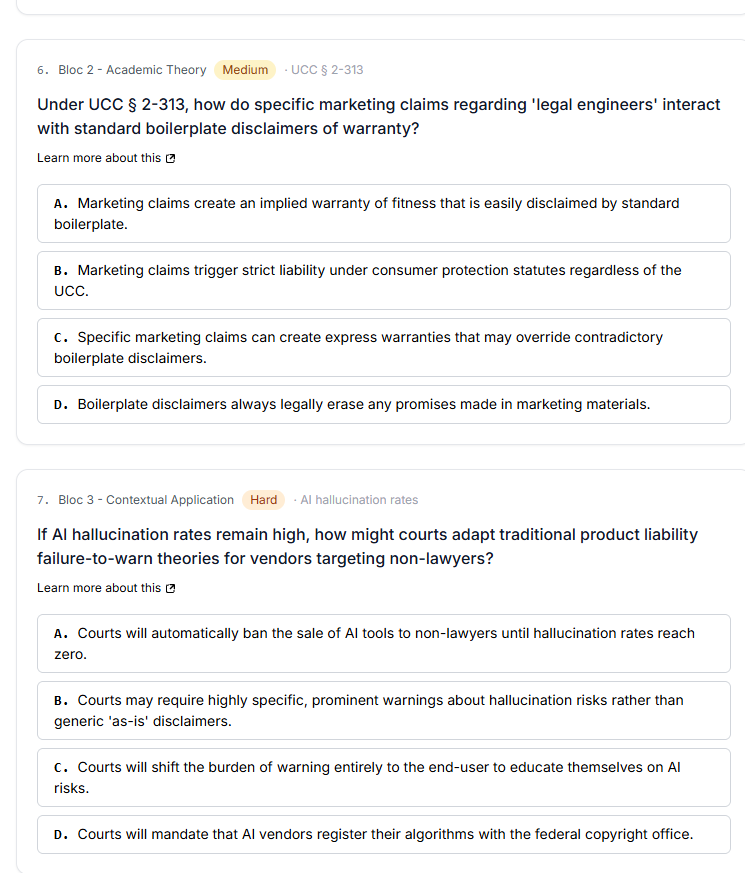
Microsoft Legal Agent Liability raises a significant question about whether contractual warnings can protect an AI provider when legal-workflow outputs cause foreseeable financial loss, particularly where the product is expressly marketed as having been developed with “legal engineers”, thereby presenting specialised legal expertise as a factor supporting the quality and reliability of its outputs.
Although “Legal Engineer” is a relatively novel title, that seem to serve a marketing purpose, research indicates that companies such as Harvey have used it for actual practising lawyers, i.e. professionals who are themselves subject to professional standards and potential liability, giving them a “certificate” of legal engineering.
The debate therefore raises a broader question: whether liability may extend to applications that seek to transform legal expertise into technology-driven, data-oriented workflows, while simultaneously relying on disclaimers to distance themselves from responsibility for the legal outputs those systems are designed to produce.
NOTE: do not take this debate the wrong way. At Solsice Legal we do have a specific approach to legal skilling, as explained in the section “Context of the debate” below.
Check the analysis, the sources, the verdict and concept training
The Thesis
Under applicable U.S. law, Microsoft may avoid liability for foreseeable economic losses caused by materially erroneous contract analysis, risk identification or redlines generated by its Legal Agent merely by stating that the tool does not provide legal advice, may produce inaccurate outputs and requires independent professional review /// even though Microsoft specifically designs and markets the product to perform structured legal workflows /// and states that its development involved professionals it describes as “legal engineers” /// and makes the tool available to users who are not necessarily licensed lawyers.
Legal Texts, Case Law, and Concepts Relied Upon
The report principally relies on the economic loss rule, Restatement (Second) of Torts § 552, negligent misrepresentation, contractual disclaimers, limitations of liability, independent professional review and the question whether a sufficiently specialised relationship could support reasonable reliance.
The opposing reasoning considers duty of care, negligent design, failure to warn, products-liability principles, unauthorised practice of law (UPL) and unconscionability, particularly where the product’s functions and marketing may affect the legal significance of a disclaimer.
The Significance of the Term “Legal Engineer”
The report treats Microsoft’s use of “legal engineers” as potentially relevant evidence, but not as an independent and systematic basis of liability at the date of the debate (september 2nd 2026).
The term may however influence how a court assesses the product’s positioning, the expertise Microsoft presents as underpinning its development, the expectations created for users and, potentially, the reasonableness of reliance on its legal-workflow outputs.
The FALSE reasoning therefore questions whether Microsoft can emphasise legal expertise, structured contract analysis and professional-grade workflows while relying upon a broad “not legal advice” disclaimer to distance itself from the consequences of erroneous outputs. Conversely, the TRUE reasoning stresses that “legal engineer” is not itself a recognised U.S. legal qualification and does not automatically transform Microsoft into a provider of regulated legal services. Its significance lies in the surrounding facts, marketing and representations rather than in the label alone.
Context of the debate
At the date of the debate (september 2, 2026) Microsoft had introduced a “Legal Agent” directly within Microsoft Word, as part of the Microsoft 365 Copilot Frontier programme. The tool is embedded in a mainstream productivity environment widely used across businesses. Microsoft 365 Copilot users can access it from within Word to analyse legal documents, review contracts clause by clause, identify risks and obligations, and perform other structured legal-workflow tasks.
The distinction from deep research plateforms such as Solsice Legal (which, at the date of the debate does require solid professional expertise and does not purport to “do the final work”) or tools such as Harvey, which appeared primarily targeted at major law firms, is that Microsoft’s Legal Agent is positioned for much broader distribution.
But this is not the real issue :
At Solsice Legal, our broader observation is that legal knowledge is rapidly becoming mainstream, driven by the proliferation of AI tools and increasingly fierce international competition, including among general-purpose platforms developed by OpenAI, Anthropic and others.
At Solsice Legal, we also value incredible models such as DeepSeek, Kimi, Gemini and many more. They all have their respective strengths and weaknesses.
In our view, having dozens of differently trained AI models at one’s disposal – together with the ability to create and deeply customise proprietary models and agents with exclusive capabilities, workflows and knowledge never shared with competitors – can itself foster greater competition and differenciation within legal services. Lawyers remain free to select the models they consider most appropriate, confront competing lines of reasoning, and launch adversarial debates whose breadth, speed and diversity of analysis would be extremely difficult to reproduce through conventional human research and single AIs alone.
And yes, Solsice legal is for research, litigation, contracts, is jurisdiction aware, and is not reserved to legal professionals, eventhough only lawyers may actually understand the implications of each debate. True legal skill is not in the raw knowledge itself, but rather in the know how, creativity… and professional liability.
And yes, in 2026, individual AI tools still make mistakes, and some “lawyers” appear surprisingly willing to place AI-generated hallucinations before courts without meaningful independent verification.
That is precisely why we built the Solsice Collective Confrontation Engine: to make multiple AI systems challenge one another, expose weak reasoning, detect and eliminate hallucination and avoid the shallow answers that can result from relying on a single model.
But the wider landscape is changing remarkably quickly. The relevant question is no longer whether AI will enter legal practice: it already has, with the active support of international law firms, professional bodies, States, courts and bar associations. AI adoption itself is not the issue at all.
The real issue :
The real issue for today’s debate is the use of the term “Legal Engineers” and its perception by users, lawyers or not.
We simply ask whether “legal engineer” is little more than a marketing buzzword or whether it can genuinely operate as a marker of quality , and, potentially, bring some degree of legal responsibility with it.
Perhaps we are particularly interested in the question because Solsice Legal itself may involve a great deal of “legal engineering”, carried out by skilled legal and finance professionals who, until very recently, had no idea they were apparently High-Calibre Legal and Finance Engineers Engineering the Solsice Engine. Sometimes marketing invents the title after people have already been doing the job for a few years. Wonderful !
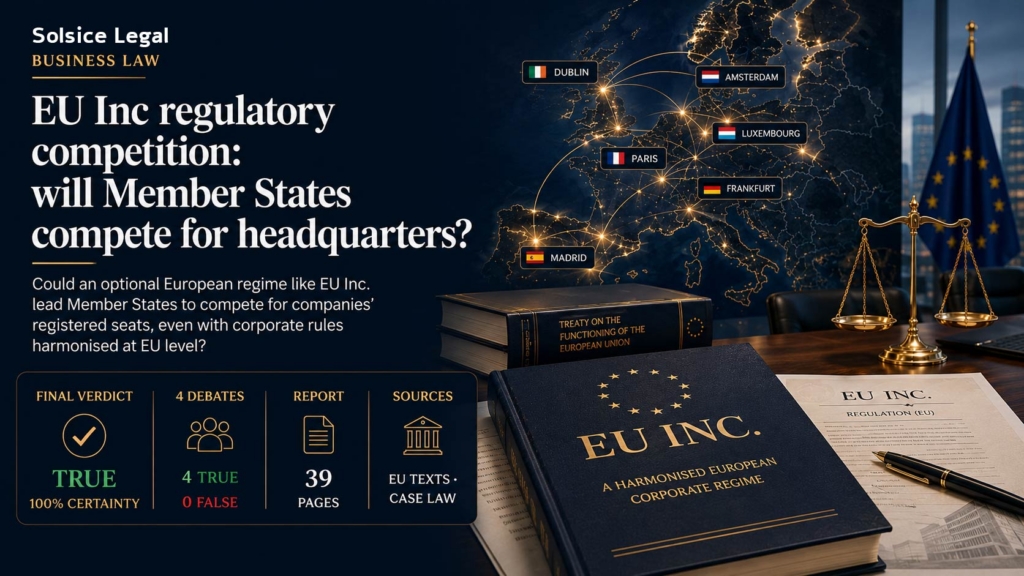
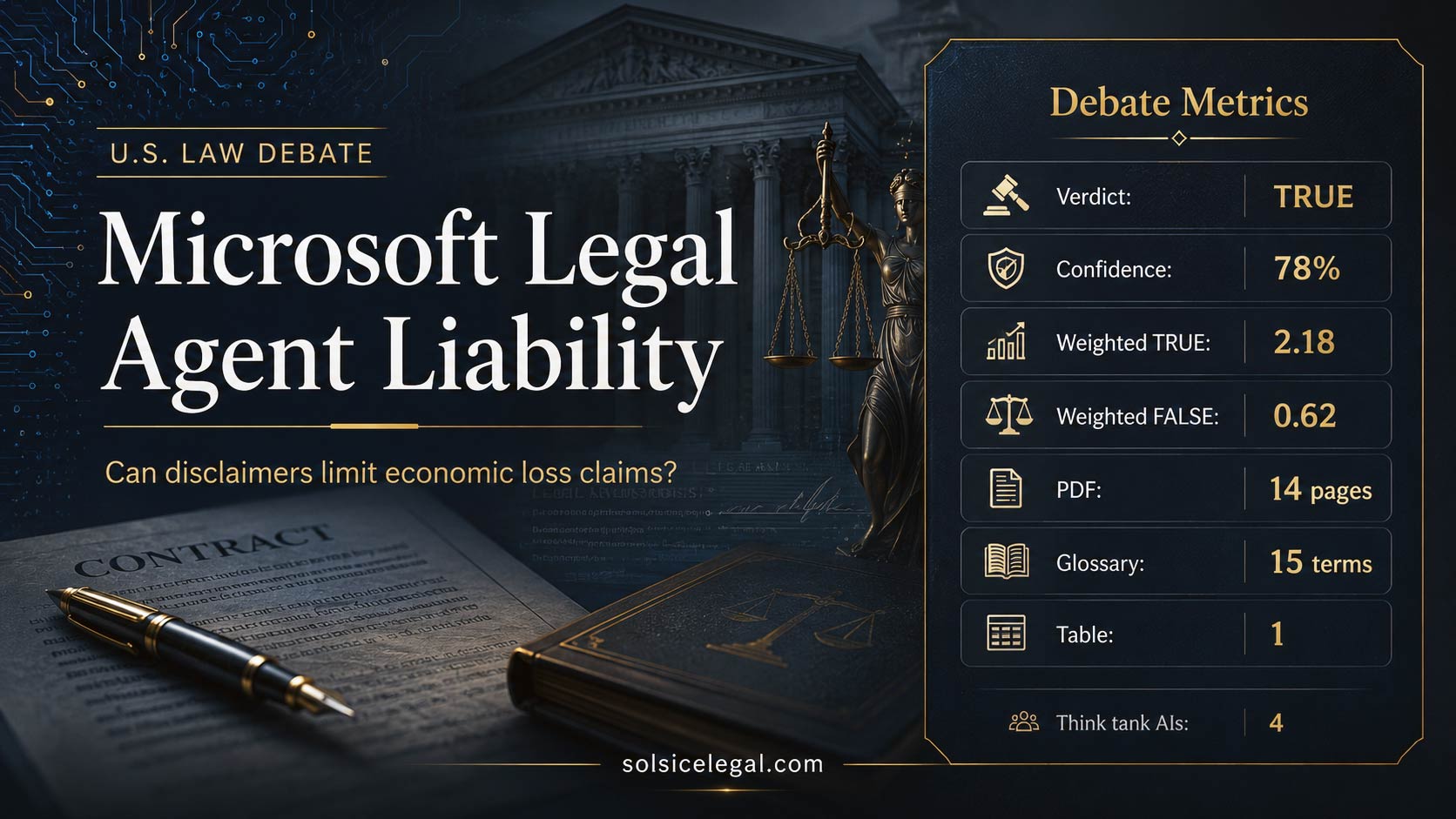
If you are in a hurry, the short answer is that the disclaimer appears likely to be effective under U.S. law, with a 78% confidence score (with a remaining 22% … ). As noted by the debate, one important reason is that the term “legal engineer” is not, in itself at the date of the debate, a regulated professional title reserved to practising lawyers and therefore does not seem to automatically carry the professional duties or liability attached to legal practice. In that sense, the label currently has rather more in common with a creative job title than with a protected legal qualification, legally speaking, perhaps closer to “ice cream engineer” than to “attorney at law”.
In another debate, we will see that this perspective is particular to the US, and is not the same in the EU.
Summary
| Description | Details |
|---|---|
| Original report | https://solsicelegal.com/public/debates/true-or-false-under-applicable-u-s-law-microsoft-may-avoid-l-09747345b13b |
| 14 pages | |
| Language | English |
| Scores | Weighted TRUE 2.18; FALSE 0.62; verdict TRUE; confidence 78% |
| Think tank AIs | deepseek-v4; deepseek-v3.2-exp; minimax-m2.7; deepseek-v4-pro |
| Arbitrator | minimax-m3 |
| Data | 15 glossary terms, 1 table. |
| Quiz language | English |
Read the debates, check the sources, understand the verdict, and take the test
Examples of questions taken from the MCQ