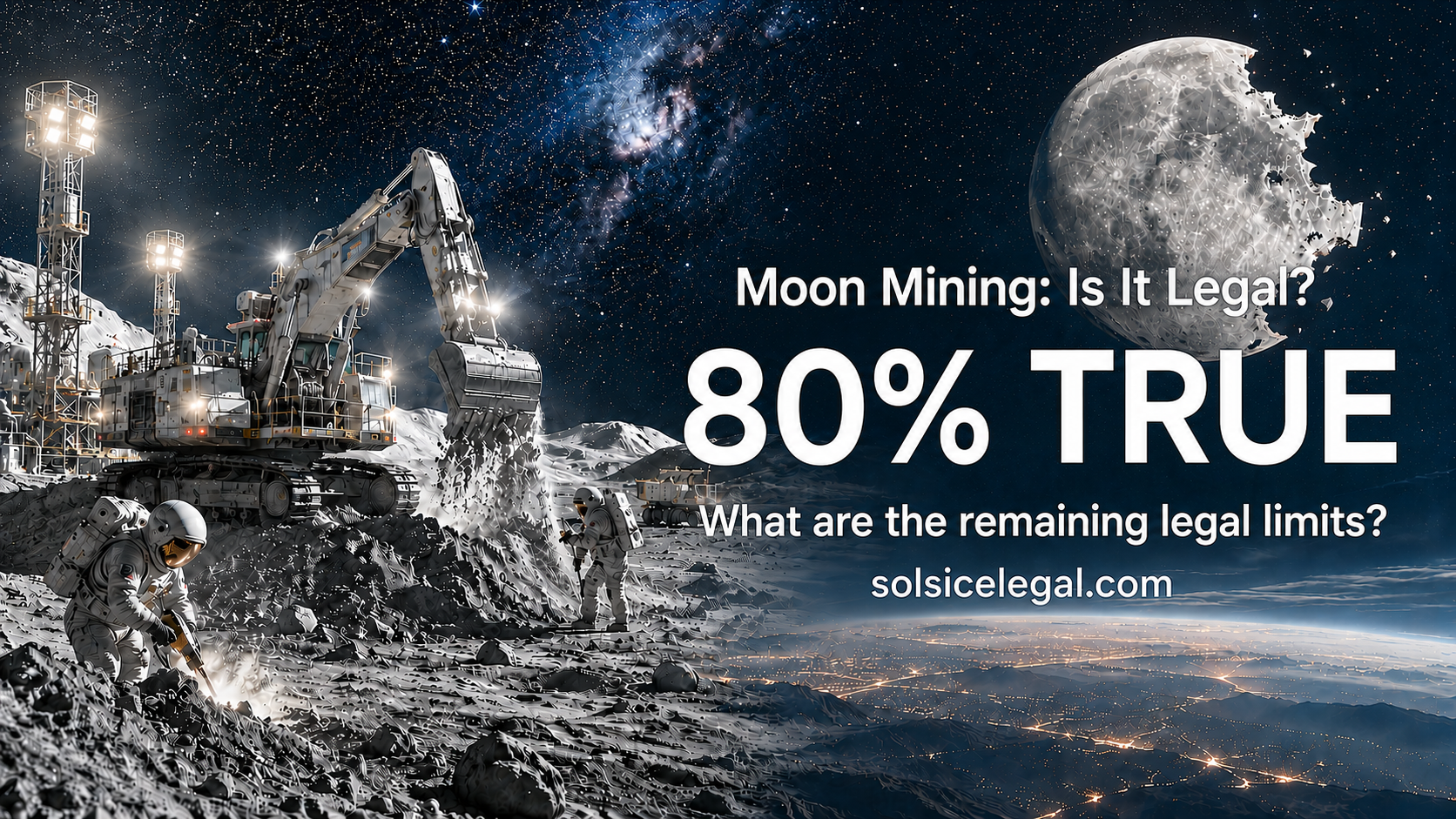
Moon mining is no longer hypothetical. Resources exist, and concrete projects are emerging (see the end of this article). From a legal perspective, the issue is to identify the applicable international conventions and determine under what conditions mining activities could take place on the Moon.
Learn how it became legal to mine the moon.
The Thesis
Under existing international law and treaties as of 2026, is it accurate to claim that // no international law or convention would prohibit a single nation from unilaterally extracting and exclusively utilizing mineral resources found on the Moon /// for its own benefit /// without sharing those resources or their profits with the international community?
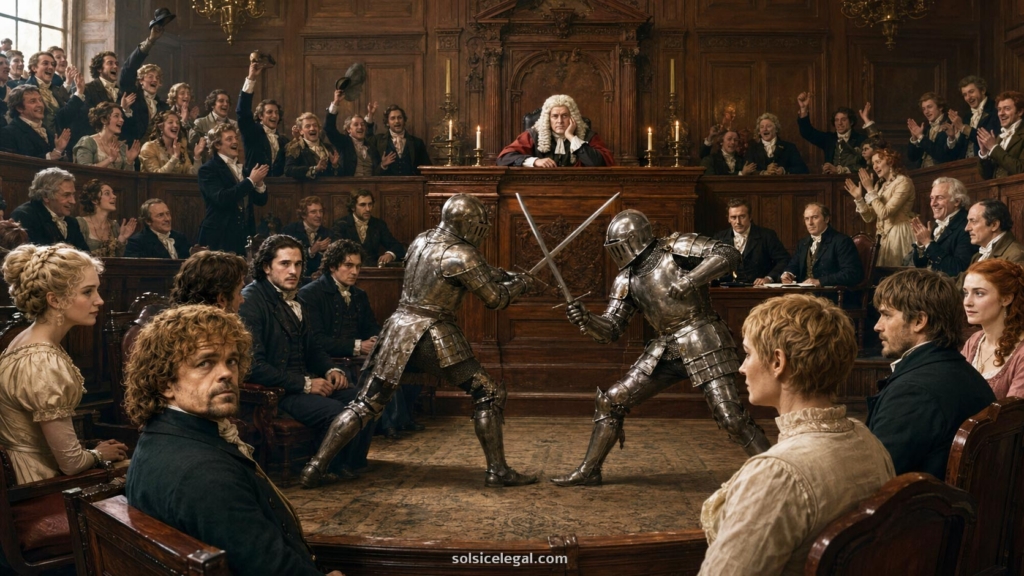
It is clearly a thesis that explores the possibility of Lunar War further to an appropriation of ressources found by anyone (as nothing in the thesis says that it is about ressources found by the mining state or company) and unwillingness to share with other nations.
See the debate, verdict and data:
https://solsicelegal.com/public/debates/aucune-loi-ou-convention-internationale-n-empecherait-l-expl-04a68d3b737b
How the Debate Unfolded
In the first confrontation, the TRUE side, supporting the possibility of mining, distinguished territorial appropriation, prohibited by Article II of the 1967 Outer Space Treaty, from the extraction and use of resources.
It also relied on the principle of the relative effect of treaties, arguing that the Moon Agreement does not bind the main States currently capable of exploiting lunar resources. According to the TRUE side, the Artemis Accords and certain domestic space-resource laws further support this more permissive interpretation.
The FALSE side relied on Article II, which prohibits appropriation “by any other means”, arguing that mining activities could implicitly fall within that prohibition.
TRUE then developed the distinction between use and appropriation, the absence of any concrete redistribution mechanism, and the principle that treaties are binding only upon their parties.
FALSE responded that this distinction remains legally disputed, particularly where exclusive, continuous and long-term exploitation could amount to de facto appropriation.
Legal Instruments and Concepts Discussed
The debate focused mainly on Articles I and II of the 1967 Outer Space Treaty, Article 11 of the 1979 Moon Agreement, and principles of treaty interpretation and relative effect derived from the Vienna Convention on the Law of Treaties.
The Artemis Accords were also discussed, particularly when assessing the legal significance of an emerging international practice that distinguishes the extraction of space resources from territorial appropriation.
The report also refers to US and Luxembourg legislation governing space resources.
One of the most interesting aspects of the debate is, fortunately, the absence of established case law specifically addressing litigation concerning actual mining activities on the Moon.
The debate therefore has to confront treaty language, legal interpretation, State practice, the opposability of treaties and the possible emergence of customary international law.
A Much Less Theoretical Question in 2026
The debate took place on 24 July 2026. One week earlier, Mauritius had become the 70th State to sign the Artemis Accords, illustrating the continued expansion of this international cooperation framework. The Artemis Accords support the position that the extraction of space resources does not, in itself, constitute territorial appropriation.
In May 2026, NASA announced a $6.9 million contract with Interlune to develop technologies designed, among other things, to extract hydrogen and helium-3 from lunar regolith.
International law is therefore beginning to face concrete industrial projects involving the exploitation of lunar resources.
Summary
| Description | Details |
|---|---|
| Original report: | https://solsicelegal.com/public/debates/aucune-loi-ou-convention-internationale-n-empecherait-l-expl-04a68d3b737b |
| 24 pages | |
| Original language | French |
| Scores | Weighted score: TRUE = 0.00; FALSE = 1.60. Final verdict: FALSE, 80% |
| Think tank AIs | 3 AIs excluding the arbitrator-clerk: z-ai/glm-5; openai/gpt-5.4-mini; anthropic/claude-opus-4.8 |
| Arbitrator-Clerk | deepseek/deepseek-v4-flash |
| Data | 11 tables in total: 5 legal tables integrated into the debates, 1 comparative matrix of the two confrontations, and 5 legal tables reproduced in the “Legal Basis and Sources” appendix |
| Concept training | French |