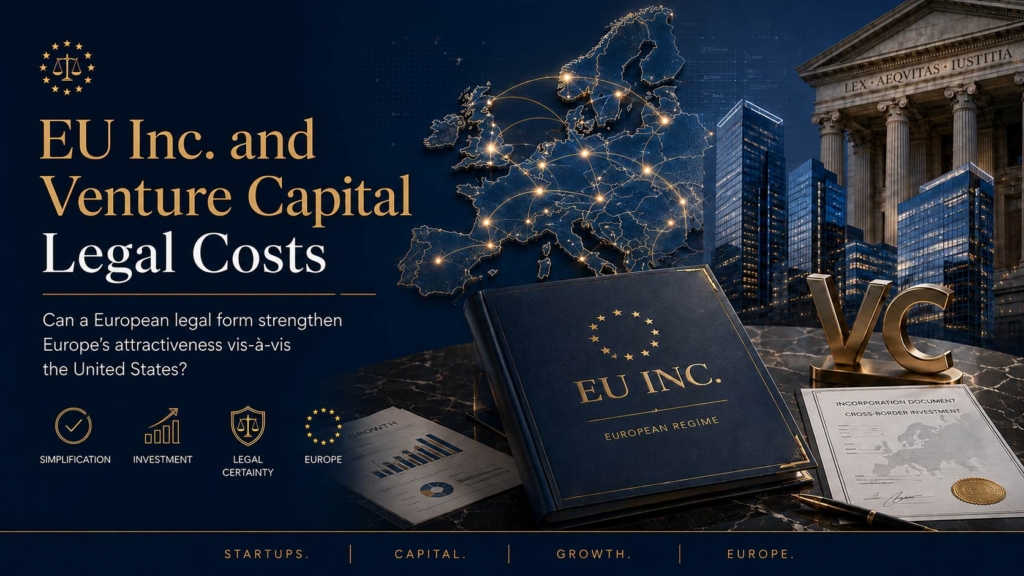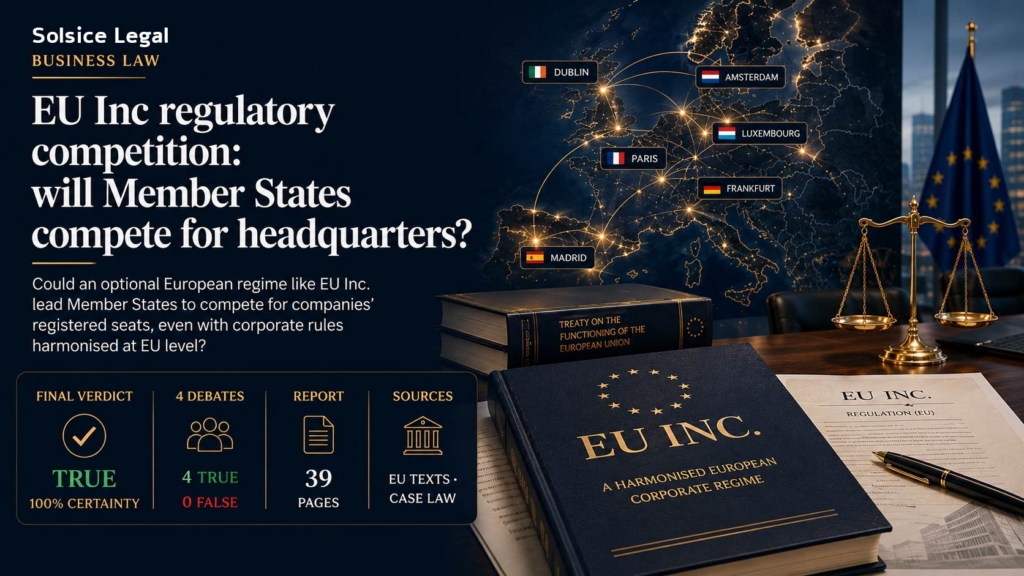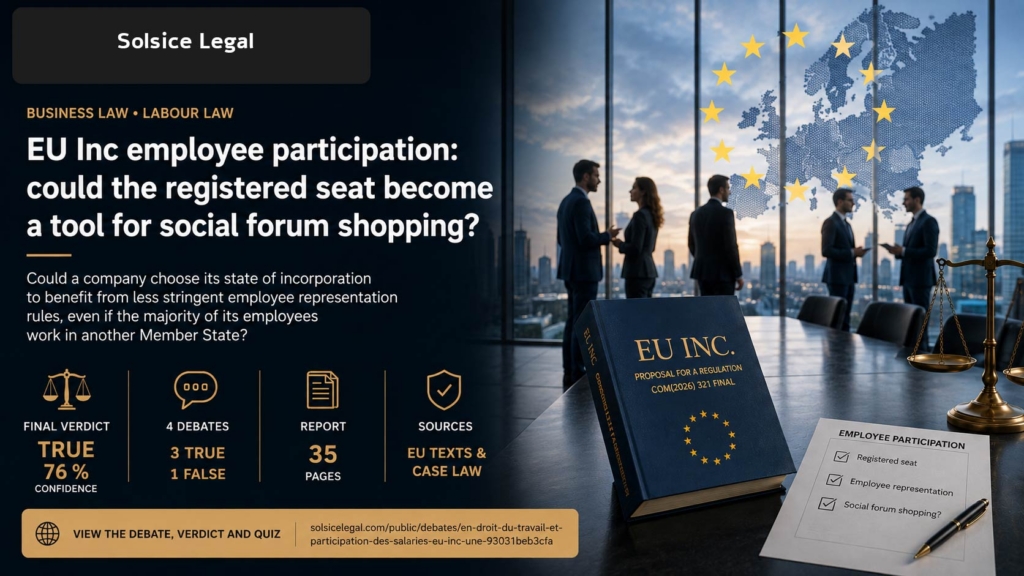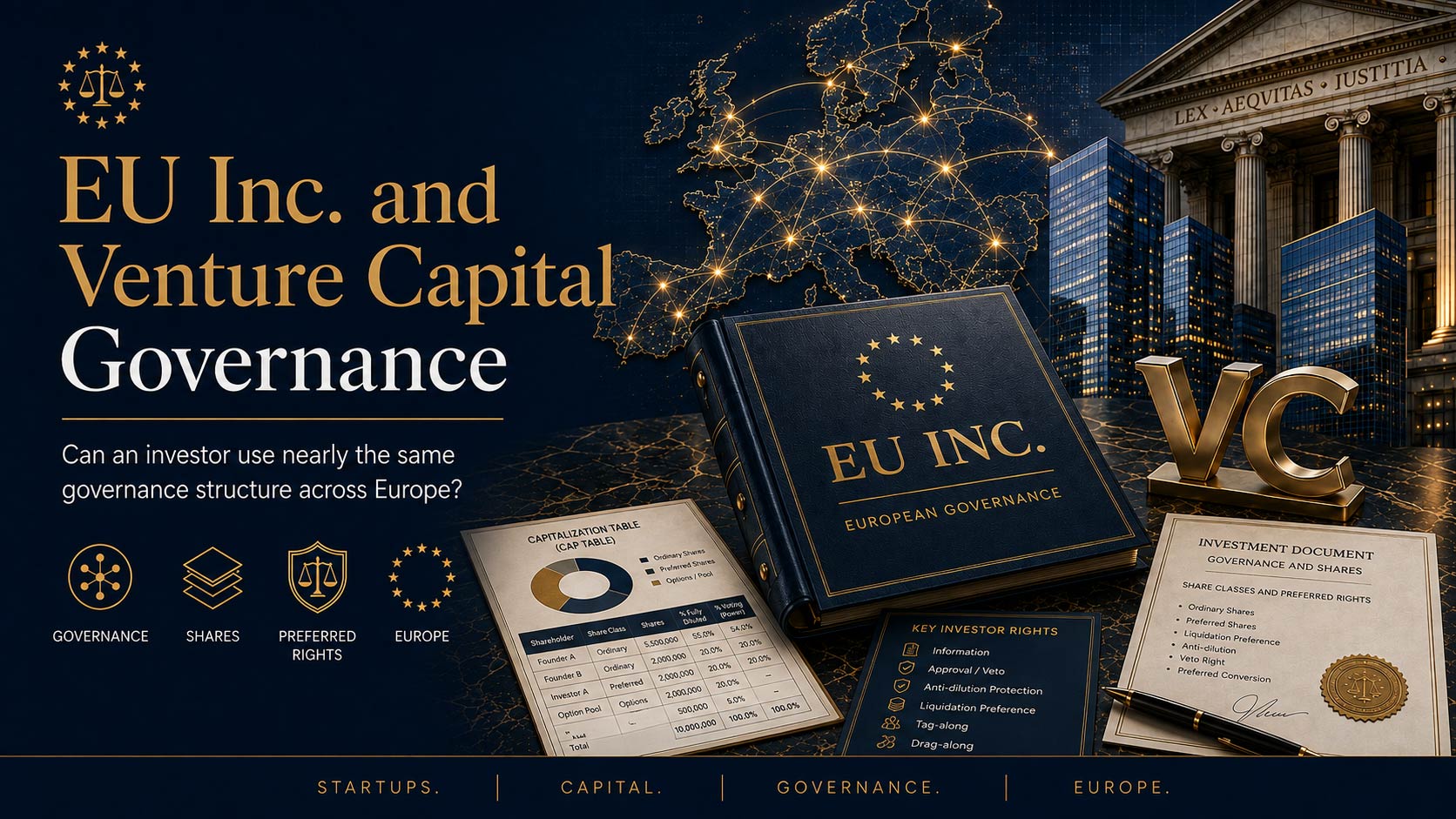
EU Inc governance could allow investment funds to use similar investment structures from one Member State to another. But how far would that standardisation actually extend?
View the debate, verdict and quiz:
https://solsicelegal.com/public/debates/le-futur-regime-eu-inc-permettrait-a-un-investisseur-de-vc-o-72d39456031e
The proposition under debate
“Would the future EU Inc. regime, a new European legal framework for companies, allow a venture capital or private equity investor to use substantially the same governance structure, preferential rights and share classes for investments made in different Member States of the European Union?”
How the debate unfolded
The TRUE side focuses on the technical core of a VC or PE investment: share classes, preferential rights, convertible instruments and constitutional governance arrangements.
- Article 55 becomes its principal argument. It allows different classes of shares to carry different rights, including rights relating to liquidation, vetoes and multiple voting rights.
The FALSE side challenges the limits of the regime.
- Article 4 preserves the application of national law to matters not covered by the Regulation or by the company’s articles. Taxation, liability, insolvency, minority protection, employment law and judicial enforcement therefore remain potential sources of divergence.
TRUE succeeds by isolating those elements which the proposed regime directly harmonises. But FALSE establishes that two EU Inc. companies incorporated in different Member States would not become legally identical. This however, is not necessarily the full answer to the question.
The tournament concludes TRUE with 74% certainty. The question is about substantial governance in the EU, and the areas that concern business and commerce follow a minimum European standard.
Legislation and legal concepts considered
The principal legal basis is the proposed EU Inc Regulation, COM(2026) 321 final, presented on 18 March 2026 on the basis of Article 114 TFEU.
The Commission proposes an optional harmonised corporate regime intended, among other things, to facilitate the establishment, financing and cross-border growth of businesses.
Article 4 governs the relationship between the Regulation, the company’s articles and residual national law.
Article 55 permits different classes of shares carrying different rights, including preferences on distributions or liquidation proceeds, veto rights, multiple voting rights and non-voting shares.
The proposal also provides for convertible instruments and warrants, as well as pre-emption rights. The report links these mechanisms to instruments commonly used in venture capital and private equity transactions: liquidation preferences, anti-dilution rights, sweet equity, board seats, drag/tag rights, SAFE instruments and KISS instruments.
A debate about the standardisation of European venture capital
The European Commission presented its EU Inc proposal on 18 March 2026. The proposal is intended, among other things, to establish a common corporate framework, facilitate capital transactions and accommodate modern financing instruments used by start-ups.
Debate summary
| Description | Details |
|---|---|
| Original report: | https://solsicelegal.com/public/debates/le-futur-regime-eu-inc-permettrait-a-un-investisseur-de-vc-o-72d39456031e |
| 39 pages | |
| Original language | French |
| Scores | Weighted score: TRUE = 2.65; FALSE = 0.95. Final verdict: TRUE, 74% certainty. 3 TRUE verdicts and 1 FALSE verdict across 4 debates |
| Think-tank models | 4 debating models: anthropic/claude-sonnet-4.6; deepseek/deepseek-v3.2-exp; google/gemini-3.5-flash-lite; xiaomi/mimo-v2.5-pro. The report counts 5 models when the arbitrator is included |
| Arbitrator / clerk | deepseek/deepseek-v4-pro, chairing the four debates and acting as Host of the Agents’ Agora |
| Data | The PDF contains 5 distinct tables : overview of the TRUE/FALSE arguments; features of the EU Inc regime relevant to VC/PE; EU-level coverage and residual national law by issue; matters harmonised or left to national law; and the matrix of the four debates |
| Quiz language | French |