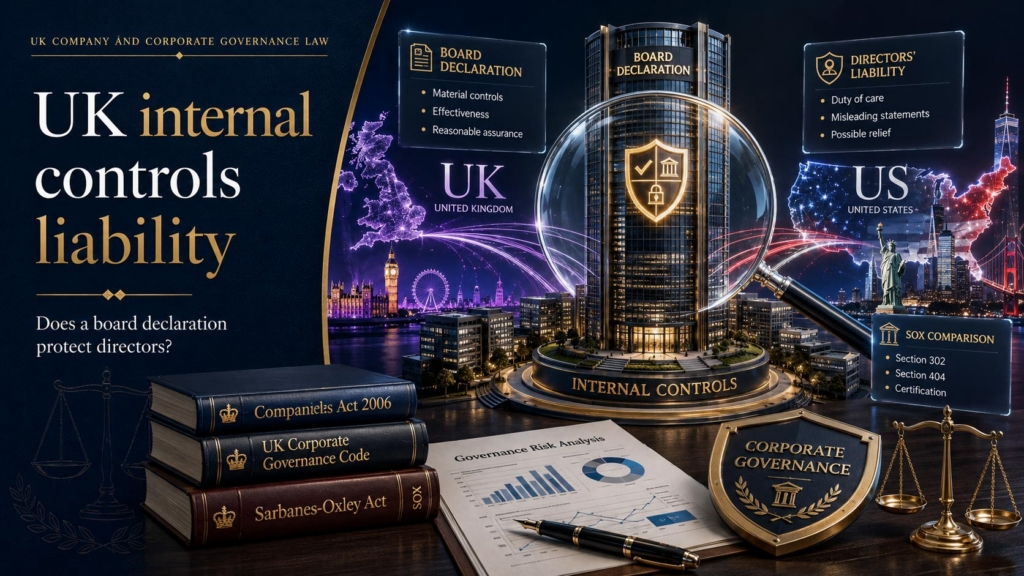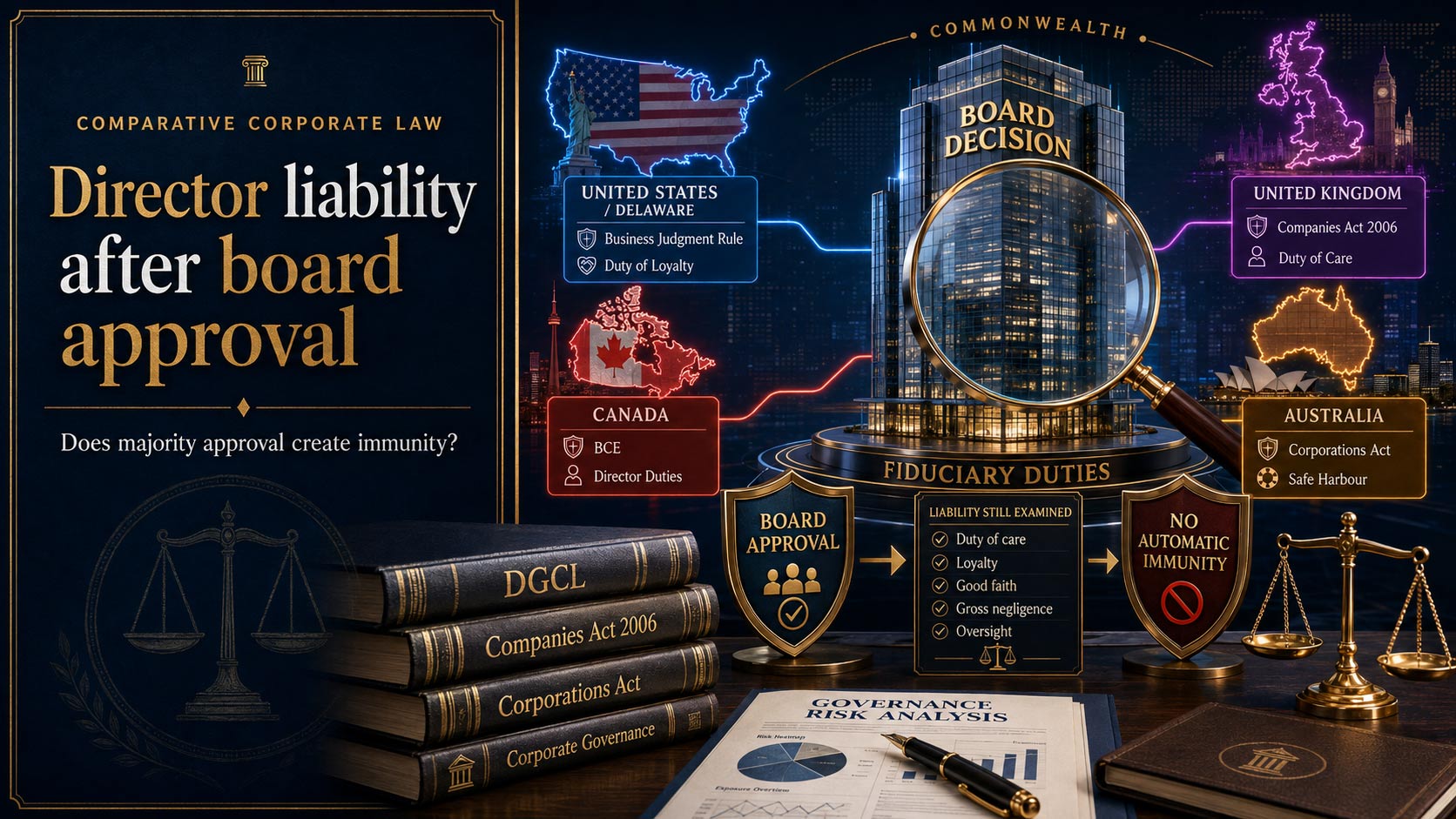
Comparative corporate law ; United States, United Kingdom and Commonwealth. Director liability after board approval is a critical governance issue when boards authorise high-risk strategies. The debate tests the boundary between collective decision-making protection and the continuing personal duties owed by individual directors.
It asks whether approval operates as substantial protection or genuine immunity.
Check the analysis, the sources, the verdict, then take the test
The Thesis
“In major corporate-law systems such as those of the United States, the United Kingdom, and Commonwealth jurisdictions, consider a director who proposes and implements a high-risk business strategy. The strategy is subsequently approved by a disinterested majority of the company’s board of directors after due consideration. TRUE or FALSE: This board approval completely shields the director from any personal liability for losses resulting from the strategy, even if a claim is brought for breach of fiduciary duty.”
Legal Texts, Case Law, and Concepts Relied Upon
The US analysis centres on the business judgment rule, DGCL §102(b)(7) and the distinction between a rebuttable presumption and complete immunity. Principal Delaware authorities include Aronson v. Lewis, Smith v. Van Gorkom, Cede & Co. v. Technicolor, In re Walt Disney Co. Derivative Litigation and Caremark, addressing informed decision-making, gross negligence, bad faith, loyalty and oversight.
The comparative analysis relies on Companies Act 2006, sections 172 and 174, Insolvency Act 1986, section 214, Re Barings plc (No 5) and Re D’Jan of London in the UK; Corporations Act 2001, sections 180(2) and 588G, together with ASIC v. Rich, in Australia; and BCE Inc. v. 1976 Debentureholders in Canada. Central concepts include duty of care, duty of loyalty, disinterested approval, safe harbour, exculpation, gross negligence and insolvency-related duties.
The most revealing aspect is how the TRUE and FALSE sides used these authorities to defend or challenge the proposition.
Example of Data Tables Available in the PDF
The report contains a tournament winner matrix and structured jurisdictional comparisons of liability-shielding doctrines, exceptions to business-judgment protection and the procedural nature of available defences.
Current or Practical Context
For boards considering acquisitions, investments or other high-risk strategies, the practical distinction is between approval as evidence of a sound governance process and approval as an absolute liability shield. The report therefore highlights the importance of the director’s own preparation, disclosure, conflicts, reasoning process, continuing oversight and jurisdiction-specific statutory protections.
Summary
| Description | Details |
|---|---|
| Original report | https://solsicelegal.com/public/debates/true-or-false-major-corporate-law-systems-including-the-unit-d7d7f07ce394 |
| 62 pages | |
| Language | English |
| Scores | Weighted TRUE 3.05 / FALSE 4.15; verdict FALSE; confidence 58% |
| Think tank AIs | openai/gpt-5.6-luna-pro; google/gemini-3.5-flash-lite; openai/gpt-4o-mini; accounts/fireworks/models/deepseek-v4-pro; moonshotai/kimi-k2.5; tencent/hy3 |
| Clerk-arbitrator | deepseek/deepseek-v3.2 |
| Data | 14 glossary terms; 7 table instances representing 4 distinct table types — one Per-Debate Winner Matrix and three jurisdictional legal-comparison tables, with the latter reproduced in the Legal Basis and Sources annex. |
| Quiz language | [metric unavailable] |
Read the debates, check the sources, understand the verdict, and take the test