
Can a dynamic IP address fall outside the scope of personal data as a result of recent European decisions?
This debate tests the boundary between classification as a matter of principle and a contextual assessment of identifiability, based on a deliberately sharp formulation.
Simple 4-AI debate.
See the debate, the verdict, and the quiz:
https://solsicelegal.com/public/debates/en-droit-francais-une-simple-adresse-ip-dynamique-ne-constit-e398d2f23876
The proposition
“Under French law, a simple dynamic IP address no longer constitutes personal data in light of the latest European decisions.”
The word “no longer” requires the TRUE side to demonstrate that positive law has actually changed.
How the debate unfolded
The TRUE side relies on the Breyer judgment to argue for a concrete assessment of the means of identification. It emphasizes the separation between the data controller and the internet service provider, as well as the legal, technical, or disproportionate obstacles to re-identification.
The FALSE side responds that this contextual approach does not amount to a general declassification. It relies on the GDPR definition, online identifiers, French case law, and the absence of any European decision overturning Breyer. Its rebuttals distinguish between an exception linked to specific circumstances and the disappearance of the principle itself.
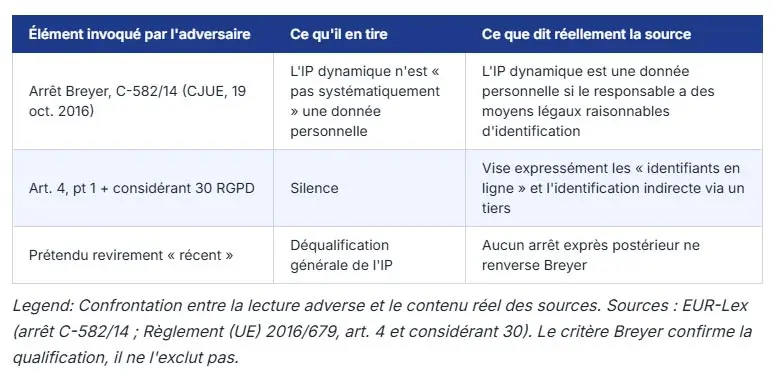
Example of table
Translation of the original screenshot in French:
| Authority cited by the opposing side | What it claims this means | What the source actually says |
|---|---|---|
| Breyer, Case C-582/14 (CJEU, 19 October 2016) | A dynamic IP address is “not automatically” personal data | A dynamic IP address is personal data where the controller has reasonable legal means of identifying the individual |
| Article 4(1) and Recital 30 GDPR | No response | They expressly cover “online identifiers” and indirect identification through a third party |
| Alleged “recent” reversal | General declassification of IP addresses | No subsequent express judgment has overturned Breyer |
Legend: Comparison between the opposing interpretation and the actual content of the sources. Sources: EUR-Lex (Breyer, Case C-582/14; Regulation (EU) 2016/679, Article 4 and Recital 30). The Breyer test confirms the classification as personal data; it does not exclude it.
Original screenshot :
A debate linked to the evolution of the notion of identifiability
As of the date of the debate, 24 July 2026, the issue is explained by the discussions triggered by EDPS v. SRB regarding the relative assessment of pseudonymised data. The report nevertheless points out that this case does not directly concern dynamic IP addresses.
Debate summary
| Description | Details |
|---|---|
| See the original report | https://solsicelegal.com/public/debates/en-droit-francais-une-simple-adresse-ip-dynamique-ne-constit-e398d2f23876 |
| 24 pages | |
| Original language | French |
| Scores | Weighted scores: TRUE = 0.00; FALSE = 1.90. Final verdict: FALSE, with 95% confidence. |
| Think tank AIs | 4 |
| Clerk-arbitrator | deepseek/deepseek-v4-flash |
| Data | 26 terms in the glossary. The tables address the criteria for identifiability, the applicable decisions, conflicting interpretations of the sources, and the scope of the main legal grounds. |
| Quiz language | French |
See the debates, the verdict, and the quiz
Some links cited in the report
https://eur-lex.europa.eu/legal-content/EN/SUM/?uri=CELEX%3A62014CJ0582
https://eur-lex.europa.eu/legal-content/EN-ES/TXT/?uri=CELEX%3A32016R0679
https://www.cnil.fr/en/sheet-ndeg1-identify-personal-data