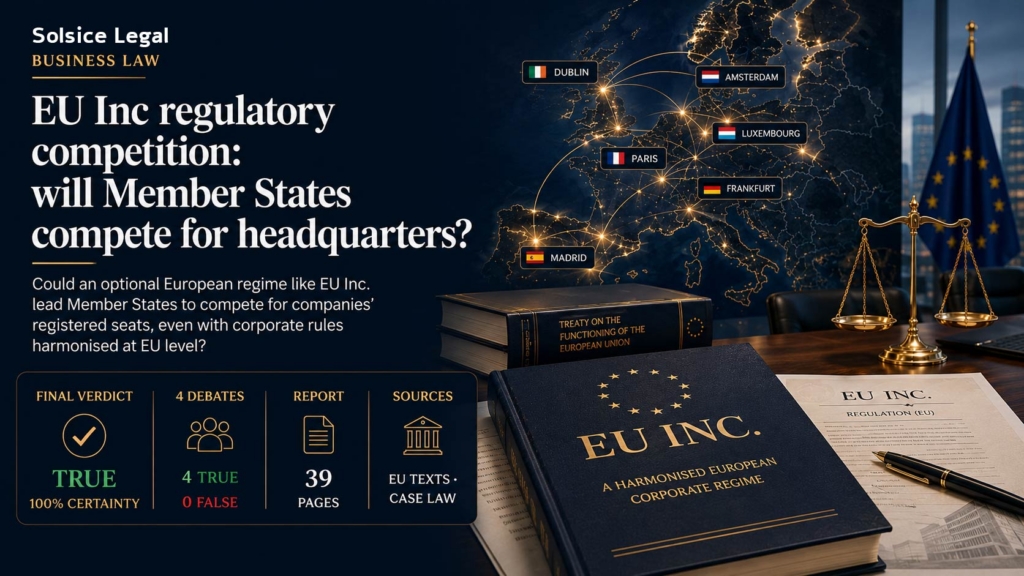
The EU Inc Regulation could materially alter how European start-ups select their Member State of incorporation. Yet freedom to incorporate in one jurisdiction does not necessarily mean freedom from the laws of the Member State in which the business actually operates.
View the debate, verdict and quiz:
https://solsicelegal.com/public/debates/si-le-reglement-eu-inc-est-adopte-dans-sa-forme-proposee-une-4528044f9b14
Thesis
“If the EU Inc Regulation is adopted in its proposed form, a European start-up could choose its Member State of incorporation primarily by reference to the quality of its laws, courts and tax environment, even where most of its economic activity is carried on in another Member State.”
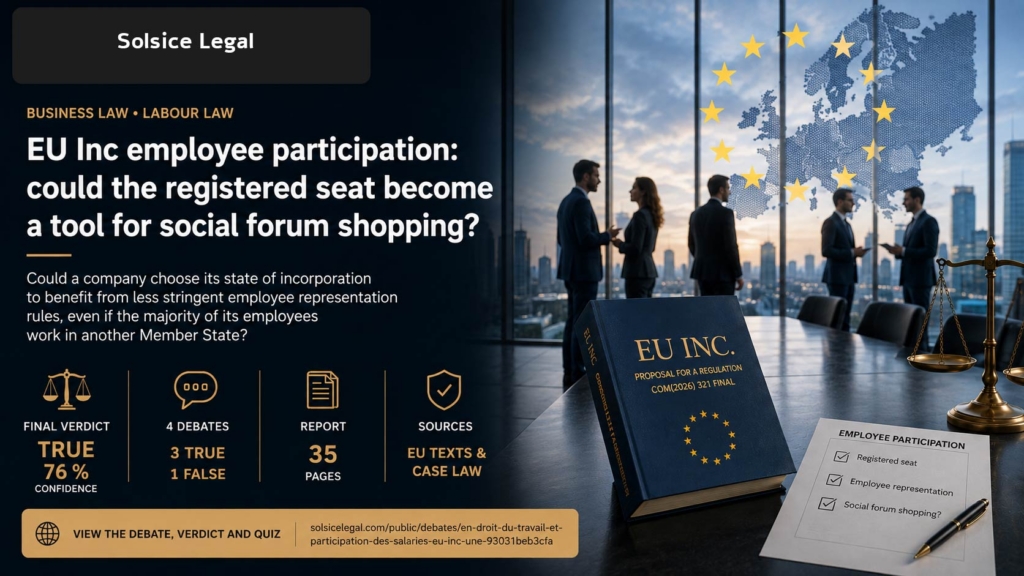
The proposition brings together three connecting factors which do not necessarily follow the same legal rules: company law, the judicial environment and taxation. Their interaction lies at the heart of the debate.
Also, we restrict the debate to the current text (If…), to avoid any development about futur amendments. In a few months, it will be possible to issue comparisons between the proposal, and the final regulation.
How the debate unfolded
The TRUE side begins with freedom of establishment and the ability, in principle, to separate a company’s registered seat from the Member State in which its economic activity is principally conducted.
Centros, Inspire Art and, in particular, Polbud are relied upon to support the proposition that a company may choose to incorporate under the law of one Member State without concentrating its substantive business operations there.
On that analysis, EU Inc would extend an existing trajectory in EU company law by providing businesses with a harmonised, optional European corporate form.
The FALSE side shifts the analysis away from incorporation itself and towards the practical limits of that choice. Overriding mandatory provisions, employment law, local regulatory requirements, economic substance and, above all, tax residence would continue to be determined by connecting factors distinct from the place of incorporation.
The rebuttal therefore turns on an important distinction. TRUE separates the law governing the corporate entity from the laws governing its actual activities. FALSE ultimately accepts that the registered seat and the centre of economic activity may, as a matter of law, be located in different Member States, but argues that the fiscal and regulatory significance of that choice would remain constrained.
All four rounds nevertheless concluded in favour of TRUE, with confidence levels of 95%, 95%, 85% and 90%. The consolidated verdict was therefore TRUE at 90%.
Legislation, case law and legal concepts considered
The report draws upon several areas of law, including EU company law, freedom of establishment, private international law and international taxation.
The line of authority running through Centros, Inspire Art and Polbud provides the principal support for corporate mobility. Cadbury Schweppes, by contrast, is considered in the context of artificial arrangements and economic substance.
The debate also addresses Directive (EU) 2019/2121 on cross-border conversions, mergers and divisions; the Brussels I Recast Regulation; the EU Insolvency Regulation; Rome I; the Anti-Tax Avoidance Directive; and the distinctions between a company’s registered office, central administration, place of effective management and permanent establishment.
Several tables in the report accordingly distinguish between matters which would be harmonised under EU Inc and those which would remain within national competence, including taxation, employment law, insolvency, procedural law and sector-specific regulation.
A debate tied to current EU developments
The Solsice debate was conducted on 10 August 2026, a few months after the European Commission formally presented its EU Inc proposal on 18 March 2026.
The proposal envisages, among other measures, an optional harmonised corporate regime together with a fully digital incorporation process.
The question was particularly sensitive in France. In July 2026, work undertaken by the French Senate had identified the possible separation between the Member State of incorporation and the Member State of substantive economic activity as a potential source of social and tax forum shopping.
The issue tested by Solsice therefore goes to one of the more consequential features of the proposed regime: could harmonising the corporate vehicle itself make the remaining differences between national legal systems more strategically significant?
Debate summary
| Description | Details |
|---|---|
| Original report: | https://solsicelegal.com/public/debates/si-le-reglement-eu-inc-est-adopte-dans-sa-forme-proposee-une-4528044f9b14 |
| 45 pages | |
| Original language | French |
| Scores | Weighted score: TRUE = 3.65; FALSE = 0.00. Final verdict: TRUE, 90% confidence |
| Think-tank models | 4 models: anthropic/claude-sonnet-4.6; google/gemini-3.5-flash-lite; deepseek/deepseek-v3.2-exp; xiaomi/mimo-v2.5-pro |
| Arbitrator / clerk | deepseek/deepseek-v4-pro |
| Data | 17 “Legal Data” tables, addressing, among other matters, EU Inc versus the Societas Europaea, the legal basis of the TRUE arguments, CJEU case law, legal and tax connecting factors, residual differences between Member States, real-seat considerations, overriding mandatory provisions, the allocation of competences between the EU and Member States, and the matrix of results from the four debates |
| Quiz language | French |
The 45-page report also includes, in its annex, a detailed matrix of the four confrontations and a consolidated presentation of the legal authorities relied upon during the debate.