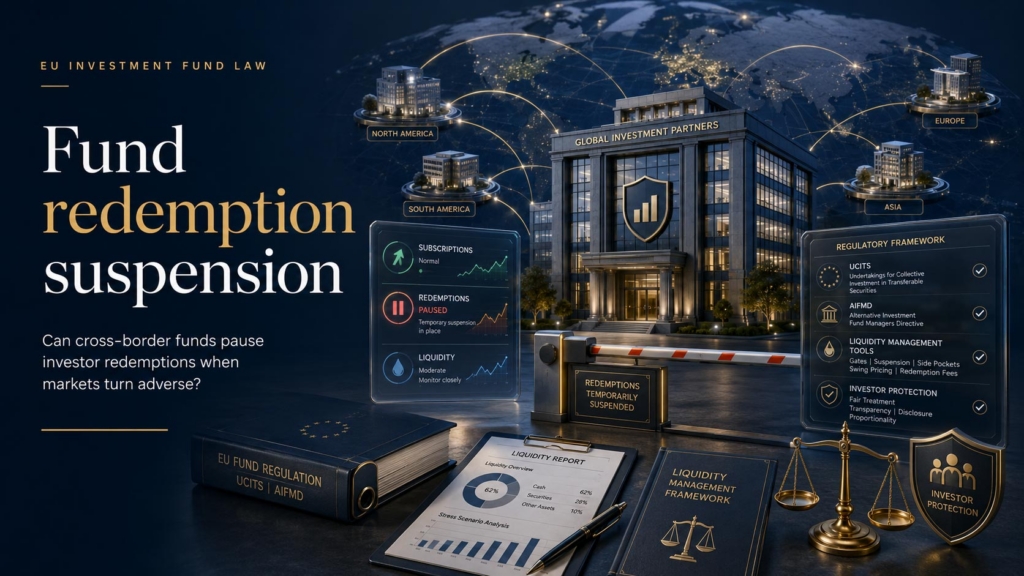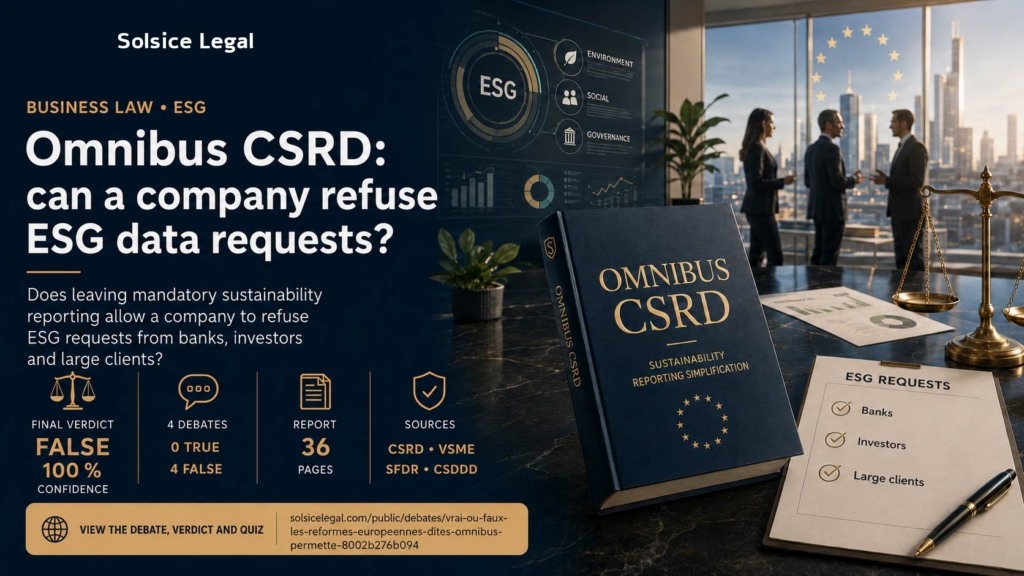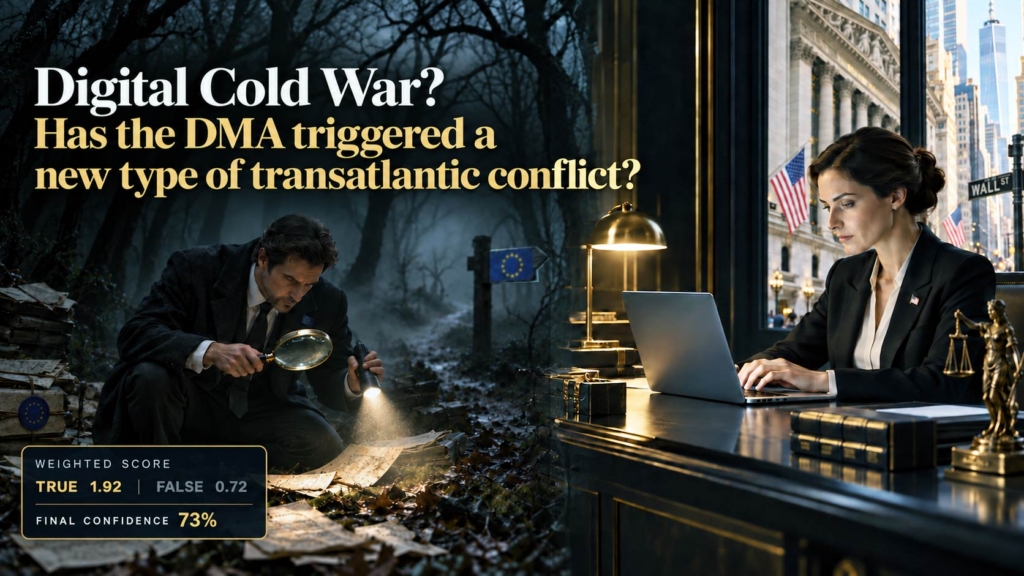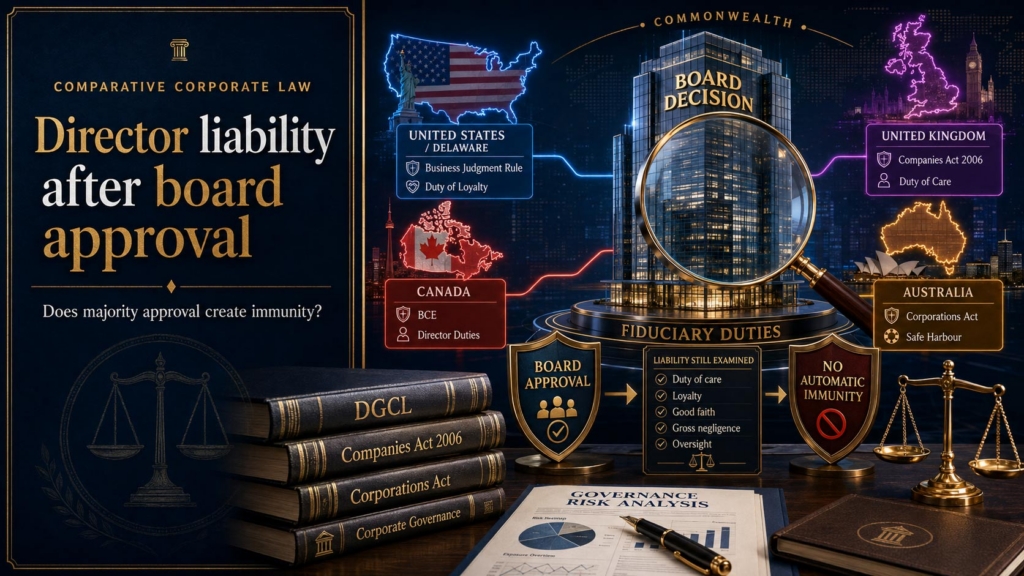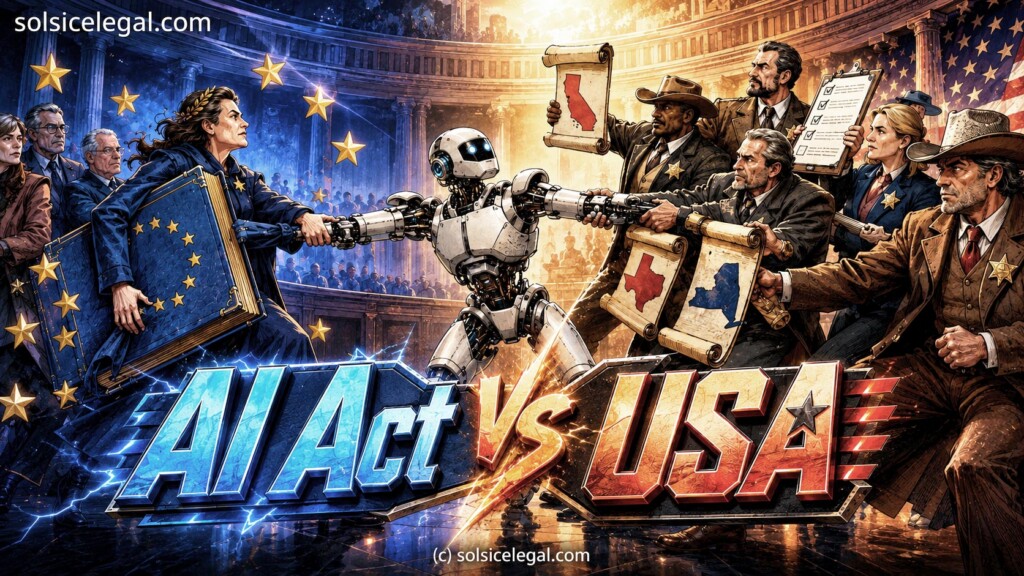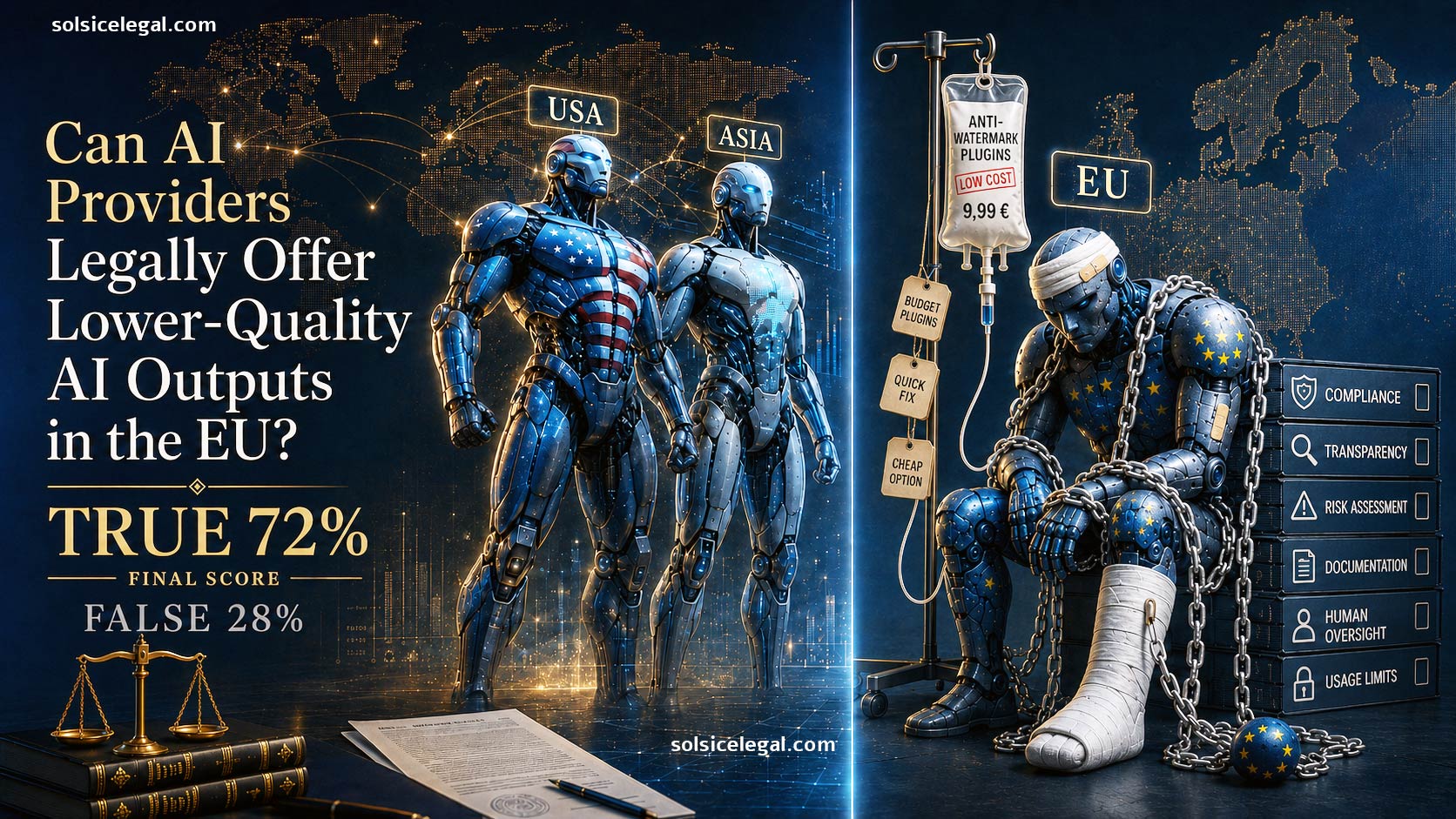
Can AI Act watermarking lead a global AI provider to offer European users lower-quality outputs than for users in countries where those constraints do not apply?
The debate tests the boundary between the territorial scope of EU law, technical compliance, and the preservation of service quality across a global AI platform.
See the arguments, sources, verdict and quiz:https://solsicelegal.com/public/debates/vrai-ou-faux-un-fournisseur-mondial-d-ia-generative-tel-qu-o-fa6f2e2ce6d6
The question
“True or false: a global generative AI provider, such as OpenAI or Anthropic, may lawfully restrict the watermarking, marking or detection mechanisms required under Article 50 of the EU AI Act to users and outputs falling within the territorial scope of the AI Act, even where those mechanisms reduce the quality, style, accuracy or fluency of responses, while offering in countries not subject to the AI Act a version of the same service free from those constraints and producing higher-quality outputs.”
In short, can a global AI provider restrict the mechanisms imposed by Article 50 of the AI Act to users who fall within the scope of EU law, while preserving non-degraded output quality for users outside that legal framework?
Arguments developed
Executive summary available in English – click the relevant flag.
Legal provisions and case law considered
The reasoning is structured primarily around Regulation (EU) 2024/1689, in particular Article 2 on its scope and Article 50 on transparency obligations. Recitals 10, 11, 12 and 133 are also relied upon to examine territoriality, the purpose of the regulatory framework and technical feasibility.
The most extensively discussed judgment is CJEU, 13 May 2014, Google Spain and Google, C-131/12, ECLI:EU:C:2014:317. The two sides rely on it in opposite ways: one to emphasise the requirement for a sufficient connection with the European Union, the other to challenge the artificial compartmentalisation of a global service.
The report also refers to French Cour de cassation, First Civil Chamber, 14 February 2018, No. 17-10.499, as part of the subsequent case law on the right to delisting.
The report contains an additional methodological point of interest: the precise legal intensity of the obligation imposed by Article 50 itself triggers an inconsistency alert that the arbitration process must resolve before reaching its conclusion. Solsice Legal therefore does more than simply confront two competing interpretations; it must also reassess certain assumptions relied upon during the earlier rounds of debate.
Context in August 2026
Article 50 of the AI Act has applied since 2 August 2026. In parallel, the European Commission has finalised a Code of Practice on the marking and labelling of AI-generated content.
At the same time, users — at least in Europe — have reported a deterioration in the quality of consumer AI outputs since August 2026, prompting independent developers to produce applications designed to remove watermarks, invisible codes and other algorithmic or textual markers, in an attempt to recover the AI they were using before august 2026.
NB: Solsice Legal incorporates mechanisms within its engine designed to preserve output quality while ensuring the clear identification of each participating AI model. Every model used is expressly identified in the report, for each argument, and specifically selected by the user for each debate.
Solsice Legal is designed primarily as a tool for adversarial legal reasoning and internal analysis, intended in particular to strengthen legal positions, test competing arguments and support the development of legal strategies. Its reports are therefore not, as a matter of principle, intended to be reproduced verbatim in communications addressed to the general public.
The present use (our blog) is primarily intended to demonstrate the operation of the user interface and, where appropriate, how it may support the creation of content, whether produced with or without the assistance of AI.
In the context of a private deployment, data scientists and developers may configure the reasoning structures, analytical workflows and virtually all of Solsice Legal’s parameters. The platform can therefore become a bespoke application, distinct from the public version and tailored to the specific requirements, methodologies and preferences of each organisation.
Debate summary
| Description | Details |
|---|---|
| View the original report | https://solsicelegal.com/public/debates/vrai-ou-faux-un-fournisseur-mondial-d-ia-generative-tel-qu-o-fa6f2e2ce6d6 |
| 44 pages | |
| Original language | French |
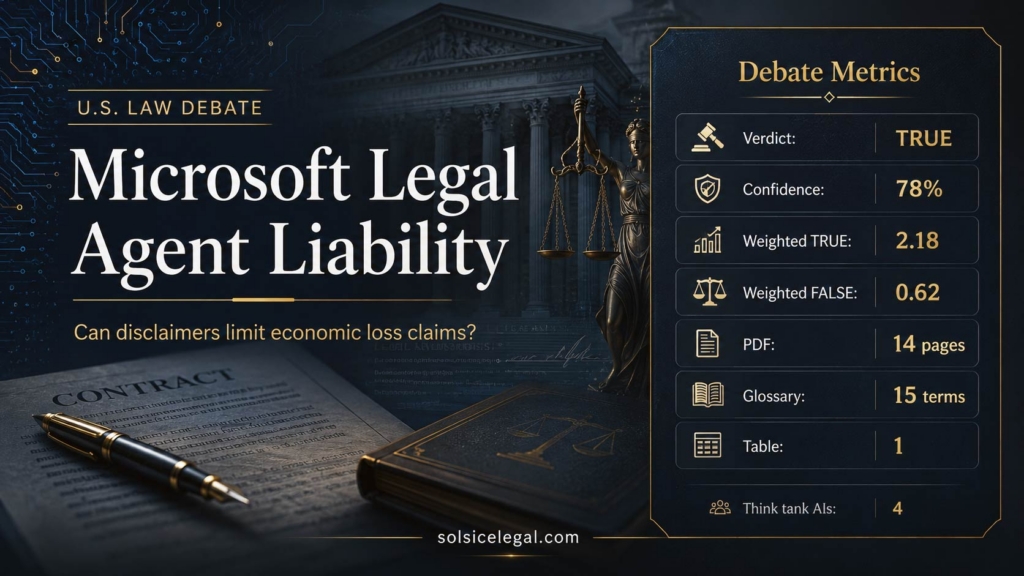
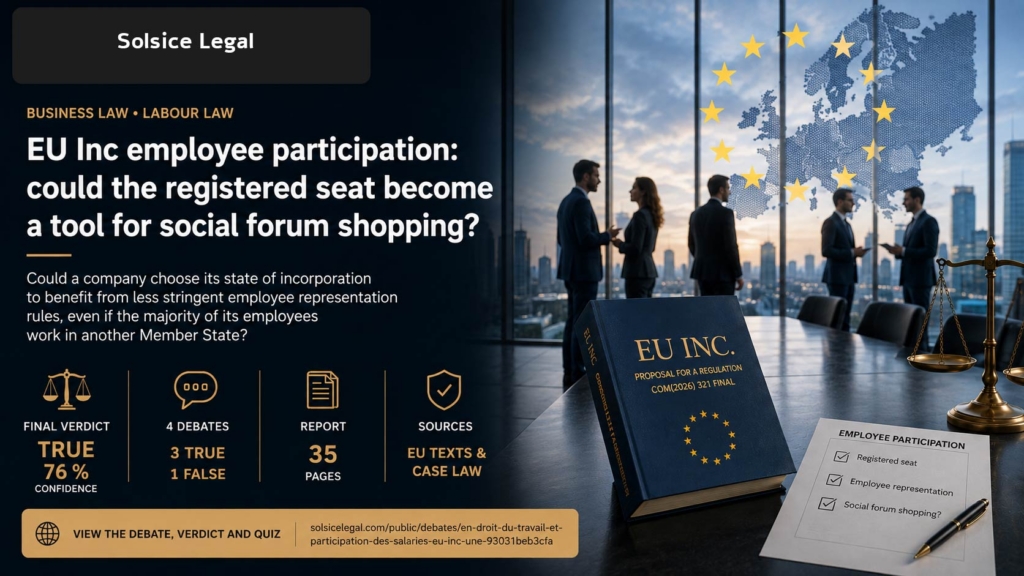
| Scores | Weighted score: TRUE = 2.15 / FALSE = 0.68. Final verdict: TRUE, with 72% confidence. Three debates concluded TRUE and one concluded FALSE. |
| Think-tank AIs | 4 AIs: deepseek-v4-pro, deepseek-v3.2-exp, gemini-3.5-flash-lite, claude-sonnet-5. |
| Arbitrator-Clerk | minimax-m3. |
| Data | 38 terms in the legal glossary. 1 table: the four-debate matrix, showing TRUE/FALSE models, tokens, winner, verdict and confidence level. |
| Quiz language | English (the private version allows the quiz language to be selected in various manners, for example according to the language of the report or question, or on the basis of a predetermined setting). |