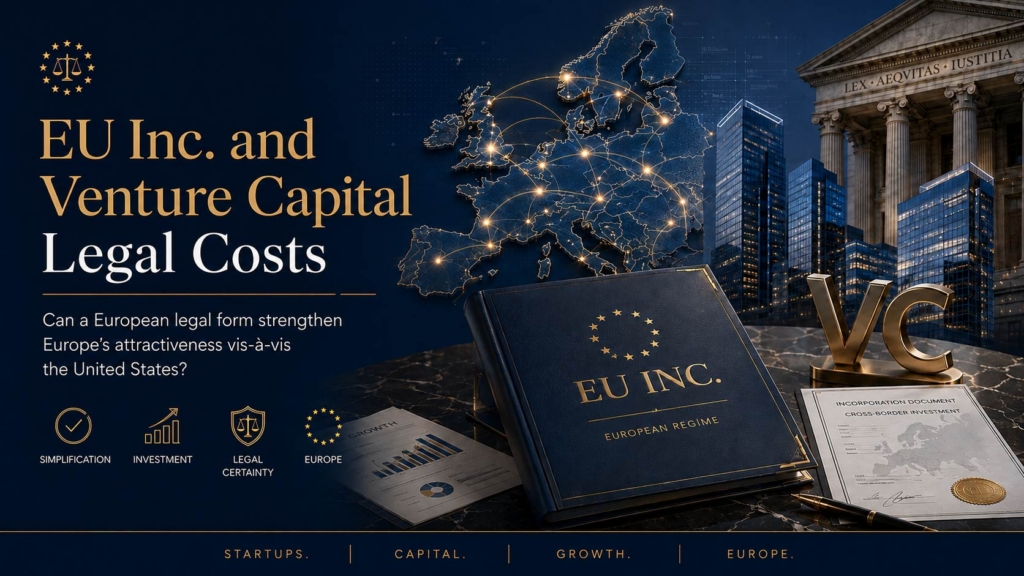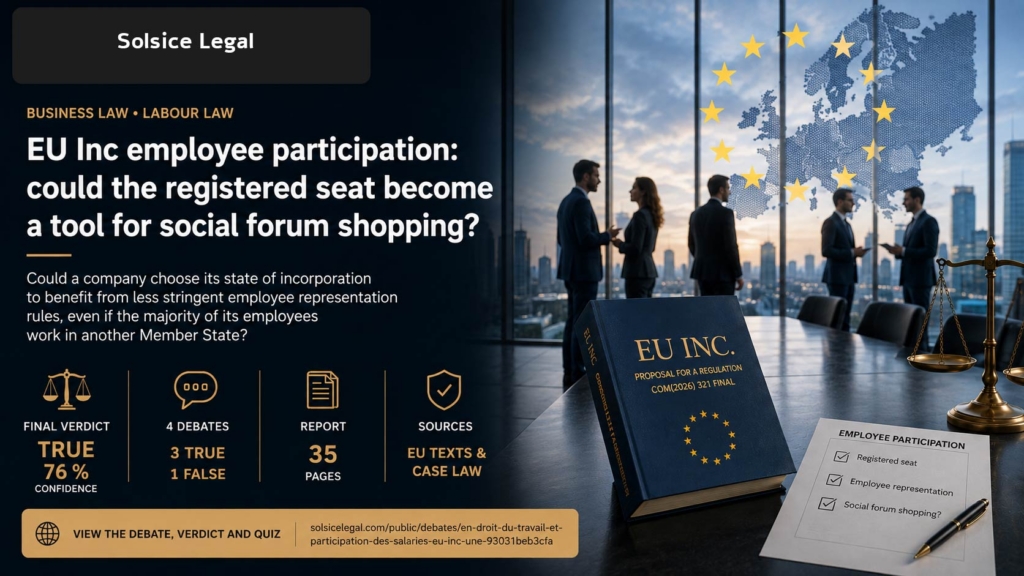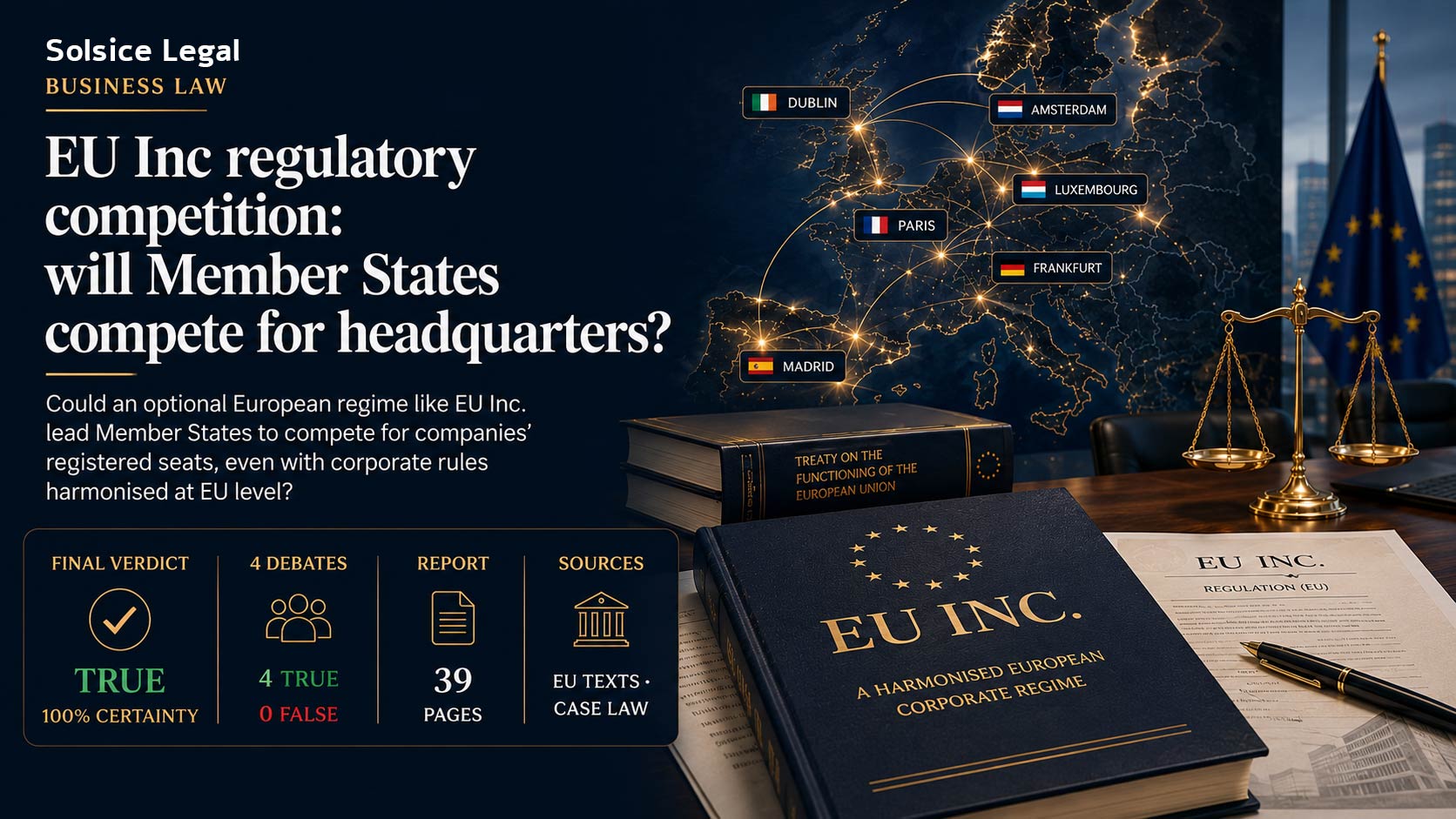
EU Inc regulatory competition raises a paradox: harmonising core company law could make the remaining differences in taxation, employment law and judicial infrastructure more visible — and potentially more relevant to corporate location decisions.
View the debate, sources, verdict and quiz:
https://solsicelegal.com/public/debates/la-creation-d-un-regime-europeen-optionnel-comme-eu-inc-pour-d81a2a443c46
The proposition under debate
“The creation of an optional European regime such as EU Inc. could result in genuine competition between Member States to attract corporate headquarters, even if the principal corporate rules are harmonised at EU level.”
The proposition tests wether removing differences in the corporate vehicle itself may increase the relative importance of those areas of national law which remain outside the harmonised regime.
How the debate unfolded
The TRUE side builds its case around incomplete harmonisation. An EU Inc. would operate under a common corporate framework, but significant matters would remain governed by national law, including taxation, employment law, supplementary company-law rules, aspects of insolvency and the judicial environment.
On that analysis, harmonising the corporate form would not eliminate competition between jurisdictions. It could instead make the remaining differences more readily comparable and commercially significant.
The FALSE side responds that such differences already exist. EU Inc. would harmonise those areas in which Member States currently differentiate themselves through incorporation requirements, formalities and the organisation of core company law. It further argues that access to capital, talent and established business ecosystems may matter considerably more to corporate location decisions than residual differences in national law.
The TRUE rebuttal introduces the distinction which ultimately proves decisive: EU Inc. could reduce administrative competition while intensifying substantive regulatory competition.
Does EU Inc create regulatory competition — or merely make existing competition more effective?
Competition between Member States for corporate activity plainly predates EU Inc. Freedom of establishment already enables companies, within limits, to select the jurisdiction in which they incorporate.
The more precise question is whether EU Inc. would alter the intensity and practical effectiveness of that competition.
By standardising the corporate vehicle and reducing incorporation friction, the regime could make differences in tax treatment, employee participation, judicial infrastructure and other residual national rules easier to identify and exploit.
The debate is therefore about whether EU Inc. could make jurisdictional choice more operationally meaningful for businesses.
Legislation, case law and legal concepts considered
The principal legislative reference is the Commission’s proposal COM(2026) 321 final, presented on 18 March 2026.
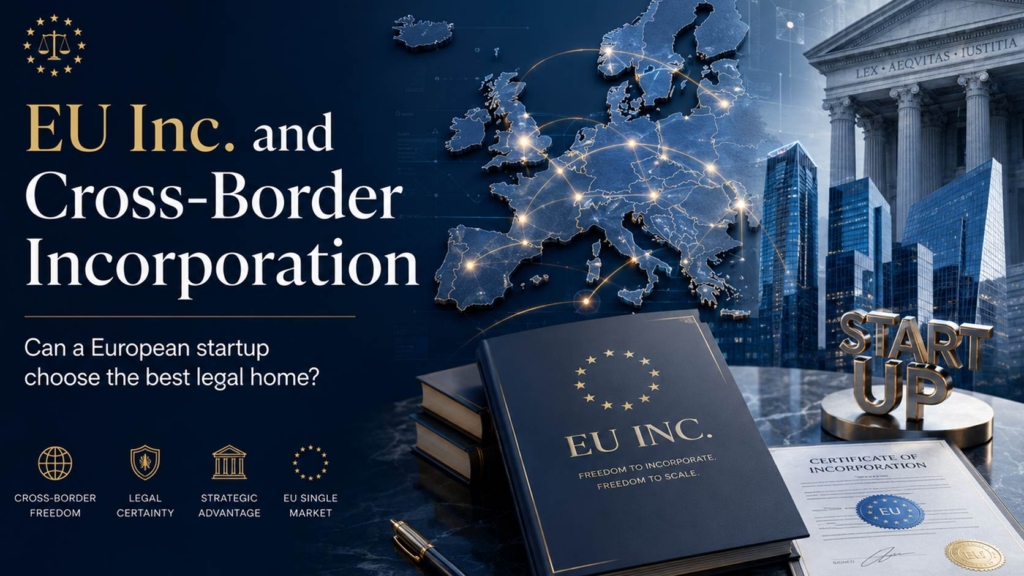
The proposed regime would introduce an optional, harmonised “28th regime”, including a fully digital incorporation process capable of being completed within 48 hours at a maximum cost of €100, together with the ability to choose the Member State in which the EU Inc. is incorporated.
The debate also relies on the EU freedom of establishment and the line of CJEU authority including Centros, Überseering, Inspire Art, Polbud and Edil Work 2.
Those authorities are used to examine the extent to which a company may select the legal system governing its corporate status even where its substantive economic activity is concentrated elsewhere.
The report further considers:
- national law applicable to matters falling outside the harmonised EU Inc. framework;
- corporate taxation;
- stock-option regimes;
- employment law and employee participation;
- insolvency; and
- the quality and specialisation of national courts.
Its central analytical distinction is therefore between the uniform EU Inc. corporate layer and the national legal environment which would continue to surround it.
A risk already identified in the institutional debate
The Commission’s model is expressly optional and available throughout the Union, allowing companies to select the Member State in which they wish to incorporate.
The proposal also envisages that Member States may establish specialised chambers or courts for disputes concerning EU Inc. company law. That possibility could itself create differences in the quality, speed and predictability of the judicial environment available in different jurisdictions.
In France, the Senate had already raised concerns during the summer of 2026 regarding potential social and tax forum shopping arising from the separation between a company’s place of incorporation and the location of its substantive economic activity.
It considered that such a structure could encourage a new form of competition between Member States.
The question submitted to Solsice therefore reflects a live institutional concern rather than a purely theoretical one.
Debate summary
| Description | Details |
|---|---|
| Original report: | https://solsicelegal.com/public/debates/la-creation-d-un-regime-europeen-optionnel-comme-eu-inc-pour-d81a2a443c46 |
| 39 pages | |
| Original language | French |
| Scores | Weighted score: TRUE = 3.38; FALSE = 0.00. Final verdict: TRUE, 100% certainty. 4 TRUE verdicts and 0 FALSE |
| Think-tank models | 4 debating models: anthropic/claude-sonnet-4.6; google/gemini-3.5-flash-lite; deepseek/deepseek-v3.2-exp; xiaomi/mimo-v2.5-pro. |
| Arbitrator / clerk | deepseek/deepseek-v4-pro |
| Data | 5 distinct tables covering: harmonised areas and residual national levers; comparative strength of the TRUE/FALSE arguments; allocation between EU Inc. law and national law; regulatory competition and remaining areas of national differentiation; and the four-round debate matrix |
| Quiz language | French |