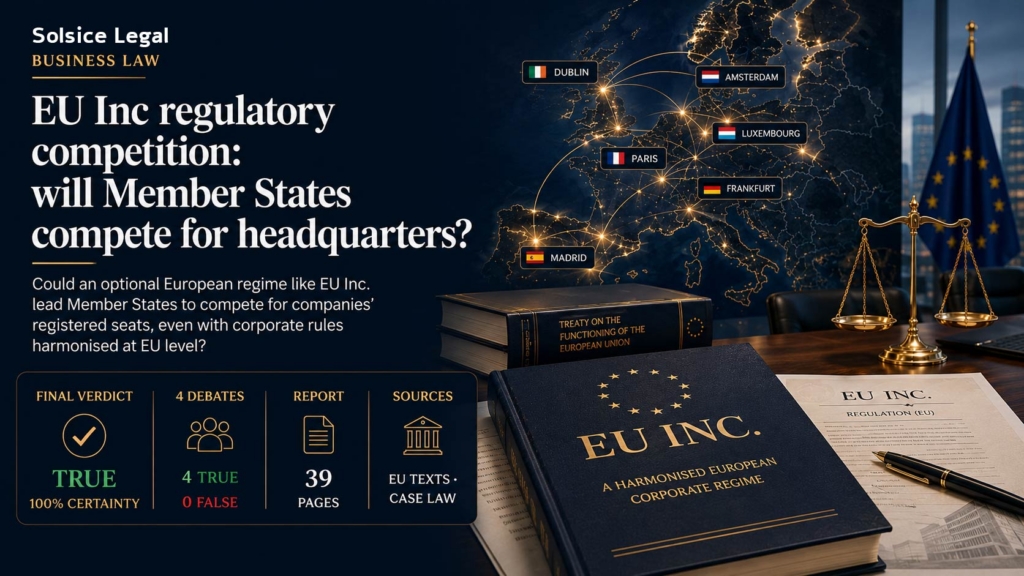
EU and comparative competition law. Below-threshold merger review has become a material transaction-risk issue for acquirers. The debate tests the legal certainty created by notification thresholds against independent competition-law mechanisms capable of reaching acquisitions after completion.
It focuses particularly on the boundary between ordinary merger control and ex post antitrust enforcement.
Check the analysis, the sources, the verdict and take the test
The Thesis
“In a jurisdiction that operates a merger control system where pre-completion notification is required only when certain statutory thresholds (such as turnover, market share, or transaction value) are met, an acquisition that falls below every one of the thresholds applicable to that transaction in that jurisdiction is categorically impossible to be reviewed by the competition authority under that jurisdiction’s competition law after the acquisition has been completed?”
Legal Texts, Case Law, and Concepts Relied Upon
The central authorities are Articles 101 and 102 TFEU, Council Regulation (EC) No 139/2004 (EU Merger Regulation) and its Article 22 referral mechanism. Most importantly, Towercast, Case C-449/21 establishes that a concentration below EU and national notification thresholds may, subject to its conditions, be examined ex post under Article 102 TFEU. The report also discusses Continental Can, Case 6/72 and the distinction between merger-control jurisdiction and substantive antitrust enforcement.
The counterweight is Illumina/Grail, Joined Cases C-611/22 P and C-625/22 P, which restricts Article 22 referrals where the referring national authority itself lacks competence under domestic merger law. French enforcement provides further practical material through Autorité Decision 24-D-05 under Article 101 TFEU and Decision 25-D-06 (Doctolib/MonDocteur) under Article 102 TFEU and Article L.420-2 of the French Commercial Code.
Current or Practical Context
By the date of the debate, ex post scrutiny was no longer merely theoretical in France: Decision 24-D-05 had examined non-notifiable transactions under Article 101, while the November 2025 Doctolib decision became the Autorité’s first sanction of a below-threshold merger under Article 102 and Article L.420-2. At the same time, Illumina/Grail reinforced the legal-certainty function of notification thresholds by limiting the Article 22 route.
Summary
| Description | Details |
|---|---|
| Original report | https://solsicelegal.com/public/debates/true-or-false-an-acquisition-that-falls-below-every-applicab-340a8fed8b6b |
| 21 pages | |
| Language | English |
| Scores | Weighted TRUE 0.00 / FALSE 1.93; verdict FALSE; confidence 100% |
| Think tank AIs | openai/gpt-5.6-luna-pro; moonshotai/kimi-k2.5; accounts/fireworks/models/kimi-k2p6 |
| Clerk-arbitrator | tencent/hy3 |
| Data | Glossary terms: [metric unavailable]; tables: 1 — Per-Debate Winner Matrix with model, score, token, winner, verdict and confidence data. |
| Quiz language | English |
This presentation is informational only and does not constitute legal advice.
Read the debates, check the sources, understand the verdict, and take the test