
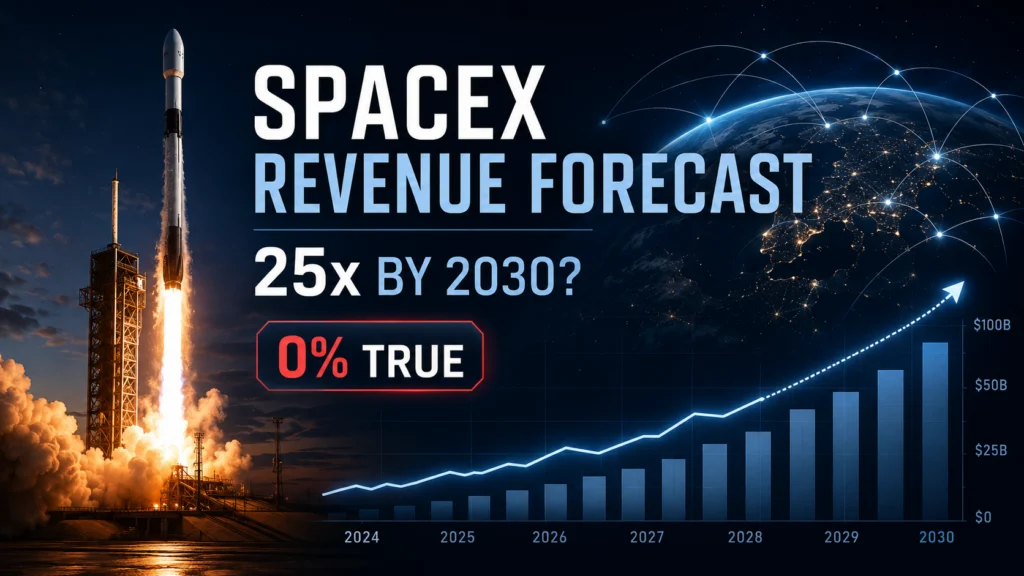






Goldman Sachs reportedly projected this week that SpaceX valuation based on adjusted EBITDA could increase 53-fold by 2030, as part of a model supporting the company’s proposed IPO valuation. Therefore, it is a clear incentive to invest in SpaceX stocks. We asked Solsice to check wether data shows that this is true or false.
SpaceX sits at the intersection of several investment narratives. It is not merely an aerospace company. It is also a launch provider, a satellite broadband operator, a defense contractor, and a potential infrastructure platform for future space-based markets. That combination makes valuation analysis unusually complex. Traditional aerospace multiples may understate the optionality of Starship and Starlink, while high-growth technology multiples may overstate the scalability of a capital-intensive business.
The question submitted to Solsice was: TRUE or FALSE: SpaceX could increase its valuation by 53x over the next five years.
| Debate summary | Details |
|---|---|
| See the full think tank debate, detailled PDF report and financial data | https://www.solsicefinance.com/public/debates/spacex-could-increase-its-valuation-by-53x-over-the-next-fiv-8d3642d192d6 |
| Solsice Verdict | TRUE 0%, FALSE 100% |
| AI involved | openai/gpt-5.1, deepseek/deepseek-v4-flash, z-ai/glm-5, mistralai/mistral-large-2512; clerk: anthropic/claude-sonnet-4.6 |
| Data | Financial entities: 35; Financial data tables: 16 |
SpaceX Valuation: a debate about magnitude, not quality
Both sides of the argument recognized SpaceX as a technologically exceptional company with strong competitive advantages in launch, reusability, vertical integration, and satellite broadband.
The key issue of the thesis is magnitude. A 53x increase from an estimated current valuation of roughly $180 billion would imply a valuation of about $9.54 trillion within five years. That number becomes the central constraint of the debate.
The FALSE side argued that even if SpaceX continues to execute well, the implied valuation would exceed the combined value of several of the largest public companies in history and would require financial results far beyond what the relevant markets appear able to support.
This is why the debate focused less on whether SpaceX is a good company and more on whether the 53x figure is economically coherent. In investment terms, the question was not whether SpaceX deserves a premium. It was whether the premium could expand to a level that would make the company one of the most valuable economic entities ever created.
The strongest TRUE argument: platform optionality
The TRUE side built its case around three major arguments.
First, Starlink could become a large recurring-revenue telecom infrastructure business. The debate referenced scenarios in which Starlink expands from millions of users today toward tens of millions by 2030, with consumer, enterprise, aviation, maritime, and direct-to-cell applications contributing to a much larger revenue base. In that view, SpaceX is not simply selling launches; it is building a vertically integrated communications network.
Second, Starship could change the economics of access to orbit. If the cost per kilogram falls dramatically, new markets may become economically viable: orbital manufacturing, in-space logistics, lunar infrastructure, point-to-point transport, and other applications that are currently speculative or uneconomic. The TRUE side treated these future markets as embedded options inside SpaceX’s equity value.
Third, SpaceX’s vertical integration creates a structural moat. The company controls launch, satellite deployment, Starlink distribution, spacecraft development, and major government mission capabilities. This reduces dependence on suppliers, supports faster iteration, and may allow SpaceX to capture margin across several layers of the space economy.
In a more moderate valuation debate, these arguments would carry significant weight. They support the case for SpaceX as a premium private-market asset. They also explain why investors may be willing to pay much more than a conventional aerospace multiple. But the Solsice debate indicates that these arguments were not enough to support a 53x increase within five years.
The strongest FALSE argument: the arithmetic problem behind SpaceX Valuation
The strongest argument against the claim was mathematical. A $9.54 trillion valuation requires either extraordinary revenue growth, extraordinary valuation multiples, or both.
The financial tables in the debate show the scale of the problem. SpaceX’s estimated 2023 revenue was presented at approximately $8–10 billion. At a 20x revenue multiple, the company would still need roughly $477 billion of annual revenue to justify a $9.54 trillion valuation. At a 15x revenue multiple, the required revenue would be about $633 billion.
Those figures are not impossible in abstract financial theory, but they are difficult to reconcile with the size of the markets discussed. The FALSE side argued that the current satellite internet, commercial launch, and government space contract markets remain far too small to produce that level of revenue within five years. Even with high market share, the addressable revenue pool appears insufficient.
This is where the evidence weighed more heavily toward FALSE. SpaceX may dominate launch. Starlink may become a large communications business. Starship may open new use cases. But moving from those assumptions to a near-$10 trillion valuation requires a pace of market creation and revenue scaling that the debate judged implausible.
Starlink is valuable, but not enough on its own
Starlink was central to both sides. The TRUE side treated it as the most credible route toward a technology-style multiple. A recurring subscription business with global reach can command a higher valuation than a traditional launch provider, particularly if it demonstrates strong gross margins and durable customer growth.
The FALSE side did not dismiss Starlink. Instead, it questioned whether Starlink could scale fast enough, profitably enough, and across a large enough serviceable market to support the 53x thesis. The debate emphasized the distinction between total broadband spending and the subset realistically addressable by satellite broadband. In developed markets, many households already have fiber, cable, or 5G alternatives. In underserved regions, affordability and infrastructure constraints may limit penetration.
The risk is that investors overextend the telecom analogy. Starlink may become a major infrastructure asset, but satellite broadband remains capital intensive. Satellites must be manufactured, launched, replaced, maintained, and supported by ground infrastructure. Unlike software, marginal costs do not necessarily approach zero at scale.
That difference matters for valuation. A high-growth software company can sometimes justify very high revenue multiples because incremental revenue may convert into high margins. A satellite network may generate recurring revenue, but it also carries substantial replacement capex and operational complexity.
Starship changes the option value, but timing remains uncertain
Starship is the most important upside variable in the debate. If it reaches full, rapid reusability and dramatically reduces launch costs, SpaceX could unlock demand that does not exist at today’s cost levels. That is the most intellectually compelling part of the TRUE thesis.
However, the verdict indicates that the timing problem remains decisive. A five-year horizon is short for building and monetizing entirely new markets. Orbital manufacturing, space-based solar power, point-to-point rocket transport, and large-scale in-space logistics may become real economic categories over time, but the debate found insufficient evidence that they can generate hundreds of billions of annual revenue quickly enough.
The strongest argument was therefore not that Starship lacks value. It was that option value should not be confused with near-term cash flow. Investors can price long-term optionality, but a 53x valuation expansion requires the market to capitalize those options at an extreme level before the revenue base exists.
Competition, regulation, and private-market opacity
The debate also highlighted several secondary risks.
Competition is increasing in launch and satellite broadband. Amazon Kuiper, OneWeb/Eutelsat, Blue Origin, Rocket Lab, national space programs, and other players may limit SpaceX’s pricing power over time. SpaceX remains far ahead in several areas, but the FALSE side argued that dominance does not equal monopoly.
Regulation is another constraint. Spectrum allocation, orbital debris rules, launch licensing, national security controls, and geopolitical restrictions can all affect growth. SpaceX operates in sectors where governments are customers, regulators, and strategic stakeholders. That creates opportunity, but also limits unconstrained global scaling.
Private-market opacity also matters. SpaceX is not a public company, so investors do not have the same level of audited financial disclosure they would have for a listed equity. Revenue, EBITDA, cash burn, debt, capex, and segment profitability are therefore harder to assess. This uncertainty may justify a premium for strategic value, but it also makes extreme valuation claims more fragile.
Investment implications
For investors, the verdict indicates that SpaceX may remain a strategically exceptional company without validating the most aggressive valuation scenario. The debate suggests a distinction between a strong business thesis and an extreme return thesis.
Potential winners from SpaceX’s continued growth include suppliers tied to launch cadence, satellite manufacturing, ground infrastructure, defense space systems, and communications hardware. Public-market investors may also monitor companies exposed to space infrastructure, satellite connectivity, and launch-adjacent services.
Potential losers include legacy launch providers, higher-cost satellite operators, and aerospace contractors whose business models depend on less efficient access to orbit. If Starship succeeds technically and economically, it could compress margins across parts of the launch ecosystem.
The valuation risk is concentrated in expectations. If private-market pricing assumes near-monopoly economics across multiple industries, any delay in Starship commercialization, Starlink profitability, subscriber growth, regulatory approvals, or defense contract expansion could pressure implied value.
The indicators to monitor are : Starlink subscriber growth and ARPU, Starlink free cash flow, satellite replacement capex, Starship launch cadence, Starship cost per kilogram, government contract wins, direct-to-cell commercialization, and evidence of real demand for new orbital markets.
SpaceX would need to demonstrate that Starship can operate at scale, that Starlink can become highly profitable, and that new markets can generate revenue far faster than current industry projections suggest. Without those developments, the debate suggests that a 53x SpaceX valuation increase over five years remains an extreme tail scenario rather than an investable base case.
See the full debate and data here:
https://www.solsice.com/public/debates/spacex-could-increase-its-valuation-by-53x-over-the-next-fiv-8d3642d192d6
Create you own content database and Reveal the truth behind the narrative with Solsice Finance