







Have you missed the century’s opportunity to buy Microsoft stock on May 26, 2026? or not ?
The question is inspired by Microsoft’s Nasdaq price chart (below) and by the type of doubt a beginner investor may have when a leading technology stock suddenly “turns volatile”shows red color”.
The main purpose of the question was to see how Solsice responds to an immediate need, possibly expressed by a non-professional user. This analysis therefore examines its ability to update core financial fundamentals with current data, within the specific context of a particular company on a specific day.
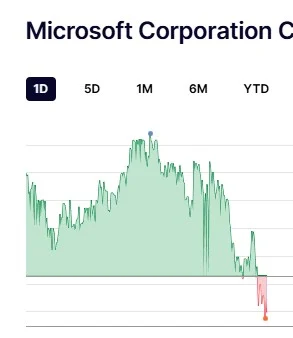
For a beginner, the visual impression can be stronger than the underlying financial reality. For a professional investor, however, the real issue is not the chart alone, venthough he looks at charts everyday.
In Microsoft’s case, the stock sits at the center of several market themes: artificial intelligence, cloud infrastructure, enterprise software, capital expenditure, valuation discipline and mega-cap technology concentration. The key issue is whether Microsoft’s AI and cloud advantages still justify buying the stock at that point in time, or whether the market had already priced in too much optimism.
The question submitted to Solsice was: True or False: it is a good idea to invest today in Microsoft Corporation Common Stock (MSFT)
| Debate summary | Details |
|---|---|
| See this debate | https://www.solsice.com/public/debates/it-is-a-good-idea-to-invest-today-in-microsoft-corporation-c-14f2ad31ce93 |
| Solsice Verdict | TRUE 76%, FALSE 24% |
| AI involved | deepseek/deepseek-v4-flash, mistralai/mistral-large-2512, deepseek/deepseek-v4-pro, openai/gpt-5.1. Clerk: anthropic/claude-sonnet-4.6 |
| Data | Financial entities: 43 terms. |
From Chart Anxiety to Investment Analysis
The starting point is useful because many investors begin with a chart. A falling line can create the impression that something fundamental has changed. But a stock chart does not explain whether the move reflects earnings risk, valuation pressure, macro stress, technical selling or short-term sentiment.
For Microsoft, the debate suggests that the chart should be treated as a signal to investigate, not as an answer. The company’s market position remains tied to enterprise software, Azure, AI infrastructure, productivity tools and recurring corporate demand. The question is therefore not simply whether the stock was down on the day. The question is whether the decline created an attractive entry point, or whether it revealed deeper concerns already building in the valuation.
This is where the debate becomes relevant for investors. It separates the emotional reaction to price movement from the financial arguments behind a potential Microsoft stock investment.
The TRUE Case: Microsoft Remains a High-Quality Compounder
The strongest TRUE argument was based on Microsoft’s revenue growth from $211.9 billion in FY2023 to $281.7 billion in FY2025. Operating income also increased from $88.5 billion to $128.5 billion over the same period. That combination supports the view that Microsoft remains a high-quality compounder, not simply a large technology company benefiting from market enthusiasm.
The TRUE side also emphasized Microsoft’s margin profile. The debate cites operating margins close to 47% and net margins around 39%. For a company still investing heavily in data centers and AI infrastructure, these figures are central to the bullish argument. They suggest that Microsoft has enough profitability to absorb major investment cycles while maintaining financial strength.
AI monetization was another major point. The debate states that Azure and cloud services grew 34% year over year in FY2025, while Microsoft Cloud revenue reached $168.9 billion. The TRUE side interpreted this as evidence that AI is not merely a narrative attached to Microsoft’s valuation, but a commercial driver already visible in cloud revenue.
The debate also points to Microsoft’s competitive moat. Azure, Microsoft 365, Teams, GitHub, Dynamics, LinkedIn and Copilot form a broad enterprise ecosystem. For investors, this matters because software ecosystems with high switching costs tend to generate durable revenue. In this view, the strongest argument was that Microsoft’s AI exposure is not isolated. It is distributed across products that already sit inside corporate workflows.
On valuation, the TRUE side argued that Microsoft was expensive but not necessarily excessive. One argument cited a trailing P/E of approximately 24.7x based on TTM diluted EPS of about $16.79. Under that interpretation, Microsoft was trading at a premium, but one that could be justified by growth, margins, balance sheet strength and strategic positioning.
The FALSE Case: Valuation and Capex Risk Remain Material
The FALSE side did not claim that Microsoft was a weak business. Its argument was more specific: even a very strong company can become a poor investment if the entry price is too demanding.
The risk is that investors were paying for near-perfect execution. The debate records ANTI arguments citing a forward P/E of roughly 35–38x, a premium to the S&P 500 and technology sector averages, and a PEG ratio between 2.3x and 2.9x. If those valuation metrics are accepted, the stock becomes more vulnerable to disappointment. A small earnings miss or slower cloud growth could create a disproportionate market reaction.
The second key concern was capital expenditure. The debate states that Microsoft’s capex rose from $28.1 billion in FY2023 to $64.6 billion in FY2025, with the first nine months of FY2026 already reaching $80.1 billion. This is one of the most important risks in the debate. AI infrastructure is not free. If Microsoft must spend increasingly large amounts to defend its AI position, investors need to monitor whether those investments produce adequate returns.
The FALSE side also argued that revenue growth was decelerating despite massive AI investment. The debate cites a slowdown from approximately 18% year over year in FY2022 to approximately 14.7% in FY2025. The key issue is therefore capital efficiency: is Microsoft spending more to generate proportionally less growth, or is the company building infrastructure ahead of a larger revenue cycle?
That question is especially important for investors reacting to a short-term chart. A sharp price decline may look like an opportunity, but if the market is starting to worry about AI returns on capital, the decline may reflect a real valuation debate rather than simple volatility.
The Central Tension: A Good Company Is Not Always an Obvious Buy
The verdict indicates that the evidence weighed more heavily toward TRUE, but the debate was not one-dimensional. The central unresolved tension was the valuation dispute. The TRUE side relied on a lower trailing P/E calculation. The FALSE side argued that the stock could be trading at a much higher effective multiple depending on the earnings base used. Solsice explicitly notes that the investment case is highly price-sensitive and that the margin of safety depends critically on the current share price.
This is the most useful takeaway for investors. The question “Should you buy Microsoft stock?” cannot be answered only by saying that Microsoft is a great company. The better question is whether the price on May 26, 2026 offered enough compensation for the risks: valuation compression, AI capex, slowing growth, regulatory pressure and market concentration in mega-cap technology.
The debate suggests that Microsoft still deserved a positive long-term view because of its structural AI and cloud advantages. But it also indicates that investors should avoid treating the stock as risk-free simply because the company is dominant.
Investment Implications
For long-term investors, the Solsice verdict supports the idea that Microsoft remained a reasonable investment candidate on May 26, 2026, especially for portfolios seeking exposure to enterprise AI, cloud infrastructure and high-margin software platforms.
The possible winners of this thesis are investors with a multi-year horizon who believe Microsoft can convert AI infrastructure spending into durable revenue growth. The possible losers are investors buying only because of a short-term dip, without considering valuation risk or capex intensity.
The indicators to monitor are clear: Azure growth, Microsoft Cloud revenue, Copilot adoption, capex as a percentage of revenue, free cash flow conversion, operating margins and analyst earnings revisions. A stronger thesis would require evidence that AI spending is producing measurable incremental returns. A weaker thesis would emerge if capex remains elevated while revenue growth slows.
Overall, the debate suggests that the answer was TRUE, but not aggressively so. The Microsoft stock investment case depended on time horizon, valuation tolerance and confidence in AI monetization. For a beginner looking at a falling Nasdaq chart, the lesson is simple: the chart raises the question, but the financial evidence must answer it.
See the full debate here:
https://www.solsice.com/public/debates/it-is-a-good-idea-to-invest-today-in-microsoft-corporation-c-14f2ad31ce93