
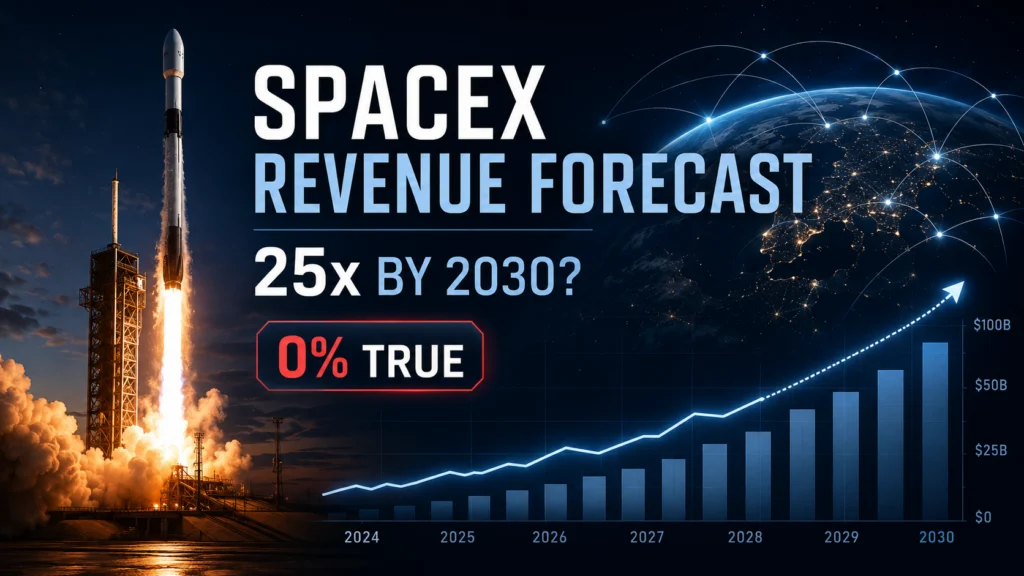






SpaceX revenue forecast assumptions to attract investors remain under pressure.
Only a few days ago, Solsice analyzed a bold media claim that SpaceX could increase its valuation by 53x over the next five years. That previous analysis concluded with a 0% TRUE score (see summary here)
The new Think Tank report focuses on a different but related question. Instead of asking whether SpaceX can multiply its valuation by 53, it examines whether SpaceX can multiply its annual revenue by around 25 by 2030.
The question submitted to Solsice was:
TRUE or FALSE: TRUE OR FALSE SpaceX will multiply its total annual revenue by around 25x by 2030, from roughly $19 billion in 2025 to nearly $475 billion, driven by Starlink, launch services and AI infrastructure revenues.
| Item | Details |
|---|---|
| See the Think Tank summary and full PDF report | https://www.solsicefinance.com/public/debates/true-or-false-spacex-will-multiply-its-total-annual-revenue-bc8d2f376eed Test included: yes, from easy to expert (click the “Concept Training” button to pass the test) |
| Number of pages of the PDF report | 15 (standard “non premium” report) |
| Solsice Verdict | TRUE 0%, FALSE 85% (100% False with 85% certainty). |
| AI involved | z-ai/glm-5, openai/gpt-5.4-mini, deepseek/deepseek-v4-flash. Clerk / Chairman: deepseek/deepseek-v4-flash. |
| Data | Financial entities: 25. Metrics used include 2025 revenue, 2030 projected revenue, CAGR, key segment drivers, model winner, verdict confidence and token counts. Margin metrics, free cash flow, EBITDA and net income are not available on page. |
From a 53x valuation thesis to a 25x revenue thesis
This new report tests a different financial object. The earlier article, available here https://customers.solsice.com/spacex-valuation-why-the-53x-thesis-scored-0-true/ focused on valuation expansion. That meant asking whether SpaceX could become worth many trillions of dollars in a five-year horizon.
The new report focuses on revenue, not valuation. That makes the analysis more operational : instead of asking what multiple investors might pay in 2030, it asks whether the underlying business can generate enough sales to justify the new scenario.
In theory, this is a cleaner test. Revenue is still subject to estimation because SpaceX remains private at the time of the report, but it is less abstract than valuation. A company may trade at different multiples depending on sentiment, rates, liquidity and scarcity. Revenue, by contrast, must be earned through customers, contracts, capacity and pricing.
However, a 25x increase in annual revenue by 2030 remains a very high bar. It requires more than continued success. It requires several business lines to scale simultaneously and at exceptional speed.
The strongest TRUE argument: SpaceX is becoming a multi-segment infrastructure platform
The pro side says that SpaceX is no longer merely a launch provider. It operates across multiple markets that can reinforce each other.
Starlink creates recurring revenue and gives SpaceX a direct customer relationship. Launch services provide internal deployment capacity and external commercial revenue. Government contracts support defense and strategic infrastructure use cases. AI infrastructure, if commercialized at scale, could add another layer of revenue optionality.
This platform argument is the strongest case for the SpaceX revenue forecast. A vertically integrated company with reusable launch capability, satellite manufacturing, broadband distribution and defense relevance can potentially capture economics across several layers of the space economy. In a more moderate revenue scenario, this argument would carry significant weight.
The pro side also emphasizes Starlink’s growth profile. Satellite broadband is already a real business, not a theoretical option. It can serve rural households, maritime users, aviation customers, military clients and enterprise networks. If subscriber growth, pricing and capacity continue to improve, Starlink can become the main operating engine behind SpaceX’s revenue expansion.
But the question is not whether Starlink can grow. The question is whether Starlink, launch services and AI infrastructure together can lift total annual revenue to nearly $475 billion by 2030. The verdict indicates that the evidence does not support that scale.
Starlink may be large, but the addressable market remains bounded
The debate suggests that Starlink is the most credible part of the bullish case, but also the easiest to overextend. Satellite broadband has a clear use case where terrestrial infrastructure is weak, unavailable or strategically insufficient. It is highly relevant in remote areas, aviation, maritime connectivity, disaster recovery, military communications and some enterprise networks.
The risk is that investors extrapolate from strong early growth into a total addressable market that may be much smaller than the implied forecast requires. In developed markets, fiber, cable and 5G already serve many high-value customers. In emerging or underserved markets, affordability can limit adoption. In enterprise and mobility markets, pricing can be higher, but volumes are narrower.
The report therefore treats Starlink as a major growth pillar, but not as a sufficient explanation for the 25x thesis. Starlink can become a very valuable communications infrastructure asset without carrying SpaceX to nearly $475 billion in annual revenue by 2030.
Launch services: strategic dominance, limited revenue pool
Launch services remain central to SpaceX’s industrial advantage. Reusability has changed the economics of orbital access, and Starship could eventually expand the range of viable space-based business models. Lower costs may enable new demand in satellite deployment, government missions, lunar infrastructure, orbital logistics or other space applications.
Still, the debate indicates that launch dominance does not automatically translate into hundreds of billions of dollars of annual revenue. Launch is strategically important, but the current commercial launch market is not large enough to justify the forecast on its own. Even if SpaceX maintains a leading market share, it still needs the market itself to expand dramatically.
This is one of the main similarities with the previous 53x valuation article. In both cases, the analysis does not reject SpaceX’s technical lead. It rejects the conversion of technical lead into extreme near-term financial scale. Starship may increase option value, but option value is not the same as booked revenue.
AI infrastructure: the decisive uncertainty
The newest and most speculative part of the thesis is AI infrastructure. The idea is that SpaceX could become more than a space and broadband company. It could also provide infrastructure for AI workloads, potentially through satellite networks, specialized compute infrastructure, defense applications or future orbital systems.
This is where the evidence appears weakest. AI infrastructure is a large and fast-growing market, but the debate suggests that SpaceX’s direct revenue visibility in that segment remains insufficient to justify the implied scale. A forecast can assign value to optionality, but investors still need evidence of contracts, capacity, pricing, margins and customer adoption.
The key problem is sequencing. For the 25x revenue thesis to work, AI infrastructure cannot remain a long-term option. It must become a major operating business by 2030. That is an aggressive assumption. It places a large part of the revenue case on a segment that appears less mature and less transparent than Starlink or launch services.
Why the verdict remains 0% TRUE
The evidence weighs more heavily toward FALSE because the thesis depends on a near-perfect combination of growth assumptions.
Starlink must scale quickly. Launch services must expand beyond their current market limits. AI infrastructure must become a very large revenue line within a short timeframe. Execution risk, market risk and disclosure risk all compound.
This is why the new report is important. It shows that reducing the narrative from 53x valuation to 25x revenue does not remove the core issue. The previous thesis was rejected because the implied valuation was too extreme. The new thesis is rejected because the operating revenue path still appears too aggressive.
The distinction matters for investors. A company can deserve a premium valuation while still failing to support the most aggressive sell-side scenarios. SpaceX may be one of the most strategically important private companies in the world, but that does not automatically validate every growth projection attached to its IPO narrative.
What investors should compare with the previous article
The previous article and the new report share a common conclusion: the problem is not SpaceX’s quality, but the magnitude of the claim. Both analyses recognize the company’s strong positioning in launch, satellite broadband and strategic infrastructure. Both also treat Starlink as the most credible near-term growth engine.
The difference is that the previous article focuses on equity value, while the new report focuses on revenue. It asks what customers must pay, what markets must open, and what segments must scale. Investors can read both together: the previous article tests valuation arithmetic, while this new report tests revenue arithmetic.
The comparison is useful to separate two forms of optimism.
- The first is multiple expansion: investors paying a much higher valuation for future optionality.
- The second is operating expansion: SpaceX actually generating enough revenue to justify that optimism.
The Solsice verdicts suggests that both forms remain difficult to support at the extreme levels discussed.
Investment implications
For investors, the practical takeaway is not to dismiss SpaceX. The company remains a strategic benchmark for space infrastructure, satellite broadband and reusable launch economics. Potential winners may include suppliers exposed to launch cadence, satellite manufacturing, ground terminals, defense space systems, advanced communications and AI infrastructure.
The main risk lies in valuation discipline. If investors price SpaceX on the assumption that Starlink, launch and AI infrastructure all reach upper-bound outcomes by 2030, disappointment risk rises materially. The losers may include public or private assets valued on similar space-AI narratives without visible revenue, as well as legacy operators exposed to SpaceX’s cost advantages.
The indicators to monitor are the following: Starlink subscribers, ARPU, churn, enterprise mix, satellite replacement capex, Starship launch cadence, cost per kilogram, defense contract wins, direct-to-cell commercialization and verified AI infrastructure revenue. The thesis could become more credible if SpaceX discloses large, contracted, recurring AI infrastructure revenue and demonstrates that Starlink can scale profitably far beyond its current base.
Until then, the SpaceX revenue forecast remains a more moderate narrative than the earlier 53x valuation thesis, but not necessarily a more investable one. The verdict indicates that the direction of growth may be credible, while the magnitude and timing remain unsupported by the data currently presented.
See the full debate here:
https://www.solsice.com/public/debates/true-or-false-spacex-will-multiply-its-total-annual-revenue-bc8d2f376eed