




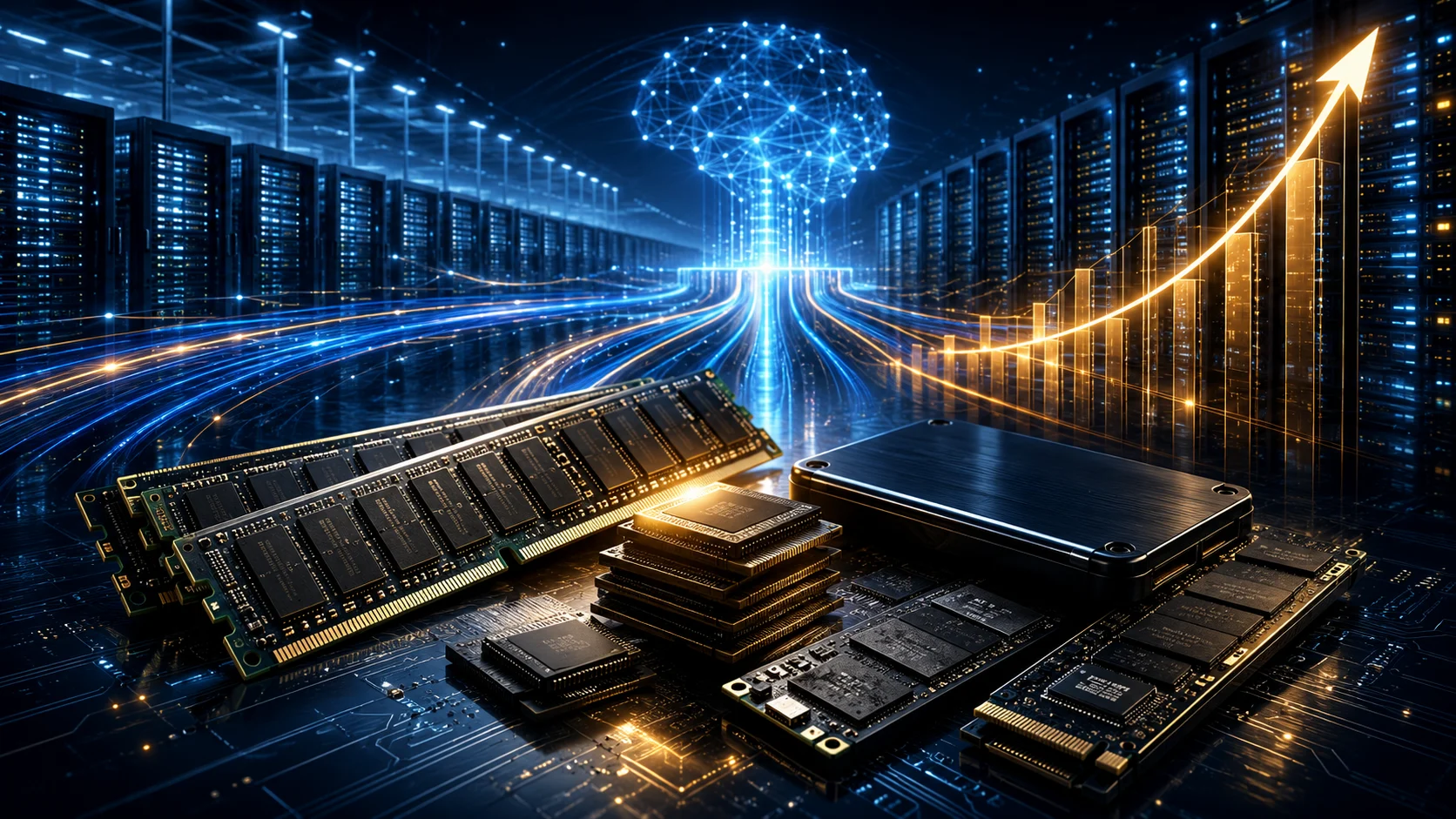
The AI boom is usually discussed through the lens of semiconductors, GPUs, cloud platforms, and large language models. But another part of the technology supply chain is becoming harder to ignore: memory and storage. DRAM, NAND, SSDs and especially High-Bandwidth Memory are no longer just background components. They are turning into strategic infrastructure for AI data centers.
The assertion submitted to Solsice was: The AI infrastructure boom is structurally repricing memory and storage, turning DRAM, NAND and SSD suppliers into higher-quality cyclical investments despite short-term consumer demand destruction.
| Debate summary | Details |
|---|---|
| See this debate | https://www.solsice.com/public/debates/true-or-false-the-ai-infrastructure-boom-is-structurally-rep-7c85718c6e4d |
| Solsice Verdict | TRUE, with a 75% confidence score. |
| AI involved | anthropic/claude-sonnet-4.6, deepseek/deepseek-v4-flash, z-ai/glm-5, xiaomi/mimo-v2-flash, openai/gpt-5.2-chat |
| Debate structure | 4 debates played, 3 votes TRUE, 1 vote FALSE. Weighted scores: TRUE = 2.73, FALSE = 0.91. |
Why This Debate Matters
For investors, the key question is not whether AI increases demand for computing components. That is already clear. The real question is whether AI changes the economics of memory and storage enough to justify a structural re-rating of the sector.
Historically, memory has been one of the most cyclical areas in technology. DRAM and NAND producers have often suffered from boom-bust cycles, driven by capacity expansion, inventory corrections, weak pricing power and consumer electronics demand. A strong year could be followed by a brutal downturn as supply caught up with demand.
The Solsice debate tested whether AI infrastructure is breaking that pattern.
The TRUE side argued that AI hyperscaler capital expenditure has created a more durable demand base. Data centers are replacing PCs and smartphones as the marginal drivers of demand. If this is correct, memory suppliers may become less dependent on consumer electronics cycles and more exposed to multi-year infrastructure spending by cloud platforms, AI labs and enterprise data-center operators.
The FALSE side pushed back with a classic warning: memory is still memory. The industry remains capital-intensive, highly competitive and vulnerable to oversupply. If current pricing is driven by shortage rather than durable pricing power, the AI boom may simply be another cycle peak.
The TRUE Case: AI Creates a New Pricing Floor
The strongest argument for TRUE was the rise of High-Bandwidth Memory, or HBM.
HBM is not ordinary memory. It is a specialized product used in advanced AI accelerators, where memory bandwidth becomes critical to model training and inference. According to the debate summary, HBM can command a 3–5x price premium over conventional DRAM. That premium matters because it creates a higher-value layer inside an industry traditionally treated as commoditized.
The TRUE side also argued that supply is contracted and constrained. Hyperscalers need guaranteed access to AI infrastructure components, and memory is now one of the bottlenecks. That changes the bargaining structure. Instead of selling primarily into volatile consumer end markets, producers increasingly sell into data-center demand backed by multi-year capital expenditure plans.
This matters for investors because a richer product mix can change earnings quality. If a larger share of revenue comes from HBM, enterprise SSDs and data-center NAND, then the sector may deserve a different valuation framework from the old consumer-driven memory cycle.
The debate also highlighted management guidance from Micron, including the idea that AI-driven memory and storage demand is outpacing industry supply. That point was important because it suggested that the shortage is not just a market narrative. It reflects operational pressure in the supply chain.
In the Solsice synthesis, the TRUE side’s core claim was clear: AI is not merely adding demand. It is replacing lower-quality consumer demand with higher-quality, less price-sensitive infrastructure demand.
The FALSE Case: The Memory Cycle Is Not Dead
The strongest FALSE argument was historical cyclicality.
Memory producers have repeatedly experienced periods when investors believed the cycle had changed. PCs, mobile devices, cloud computing and now AI have all been presented as structural demand shifts. Yet pricing power often disappeared once producers expanded capacity.
The debate cited Micron’s financial history as a warning. A sector that can swing from large profits to major losses within a short period is not easily transformed into a stable compounder. Even if AI demand is strong today, the supply response can be equally powerful.
The FALSE side also argued that HBM still represents only part of the total memory market. Even if HBM is premium-priced, much of DRAM and NAND output remains commodity-like. Consumer electronics may be weaker, but they have not disappeared. PCs, smartphones and consumer SSDs still influence volumes, pricing and inventory cycles.
Another important counterargument was capacity expansion. If Samsung, SK Hynix, Micron and other producers invest aggressively to capture AI-driven demand, today’s shortage can become tomorrow’s oversupply. In memory markets, high margins often attract new capacity, and new capacity eventually pressures pricing.
That is the classic investor trap: buying the structural story at the top of the cycle.
Why Solsice Concluded TRUE
Solsice ultimately concluded TRUE because the debate judged that AI has changed the composition of demand enough to support a structural repricing thesis.
The key point is not that memory has become non-cyclical. It has not. The sector will probably remain volatile. The TRUE verdict instead suggests that the quality of the cycle has changed. AI infrastructure may have created a higher pricing floor, stronger demand visibility and a more valuable product mix.
That distinction is important. A sector can remain cyclical while becoming a higher-quality cyclical investment. Energy, semiconductors, shipping and industrials have all experienced moments where structural changes altered the risk-reward profile without eliminating cyclicality.
For memory and storage, the investor question is therefore subtle. The opportunity is not simply that RAM and SSD prices are rising. It is that AI may be turning previously commoditized components into strategic bottlenecks.
This also has a consumer-facing dimension. If AI hyperscalers pre-order massive volumes of memory and storage, availability for consumer hardware can tighten. That can push retail prices higher for RAM, SSDs and PCs, even when consumer demand itself is weak. In practical terms, households and small businesses may pay more for components because the most valuable supply is being redirected toward AI infrastructure.
That creates a broader investment signal: when consumer prices rise despite weak consumer demand, the marginal buyer may have changed. In this case, the marginal buyer is not the retail PC user. It is the data center.
Investment Implications
The Solsice verdict points toward a sector-level thesis rather than a simple AI headline. The potential beneficiaries are memory manufacturers, HBM suppliers, enterprise SSD providers, advanced packaging companies and infrastructure-linked semiconductor supply chains.
The risk is that investors overpay for a cyclical peak. If AI capex slows, if HBM capacity expands too fast, or if hyperscalers negotiate prices down, the structural repricing argument could weaken quickly.
But for now, the debate suggests that AI has moved memory and storage from a secondary hardware category to a central investment theme. The question is no longer just who builds the best AI models. It is also who controls the components required to run them.
Solsice’s verdict is therefore not a claim that memory suppliers have become safe investments. It is a claim that their economic role has changed. AI infrastructure may have made DRAM, NAND and SSD suppliers more strategically important, more profitable at the margin, and more relevant to institutional investors looking beyond the obvious AI winners.
See the full debate here:
https://www.solsice.com/public/debates/true-or-false-the-ai-infrastructure-boom-is-structurally-rep-7c85718c6e4d